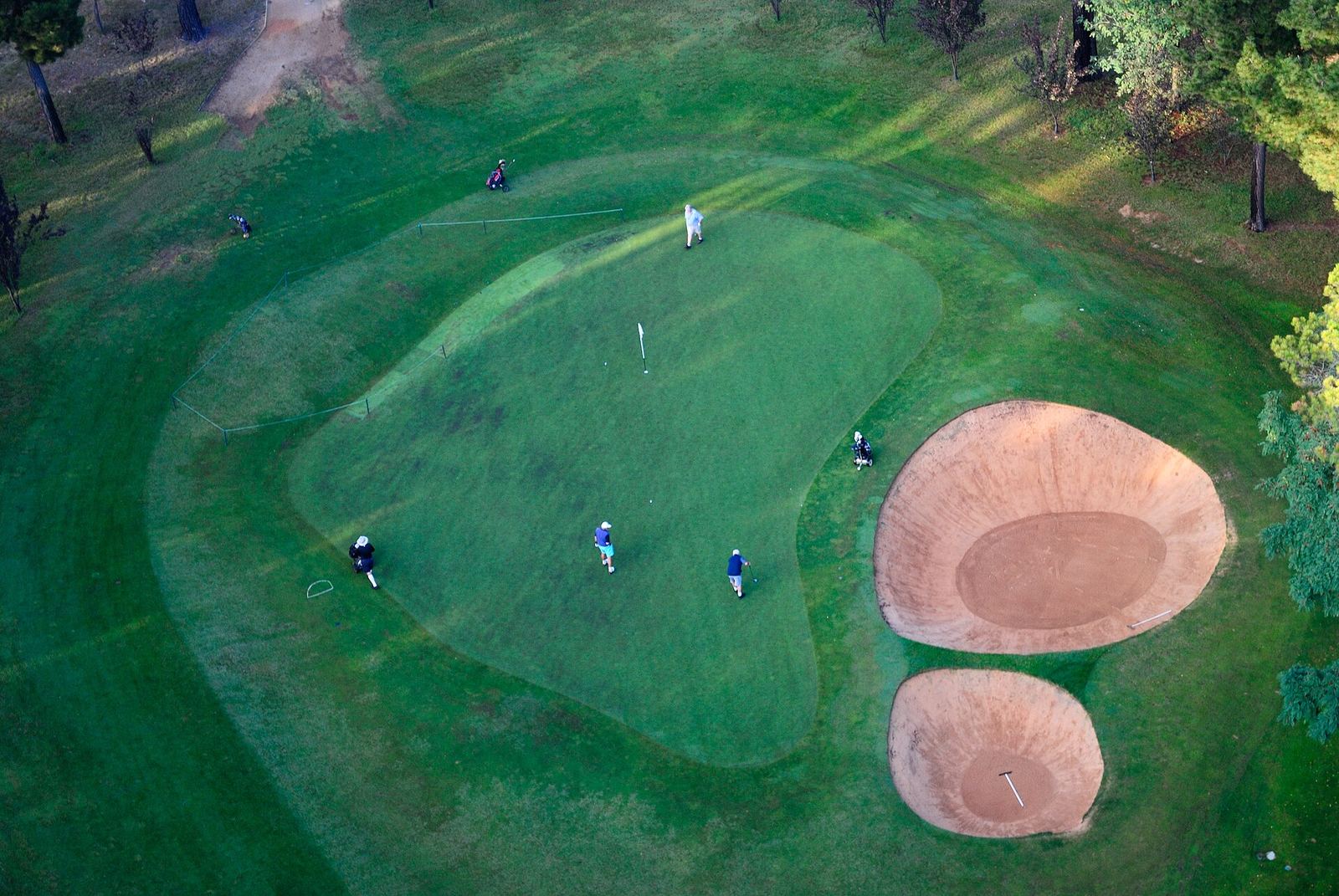
The main parts of a golf course are the teeing area, fairway, rough, bunkers, penalty areas (water and other marked hazards) and the putting green, plus the out-of-bounds edges that frame each hole. The Rules of Golf group them into five areas: the teeing area, general area, bunkers, penalty areas and putting green.
Every hole is built from those same pieces, whether it’s a 106-yard par 3 at Pebble Beach or a 600-yard par 5 at your local muni. Once you know what each part is for, a scorecard stops being a list of numbers and starts to look like a plan: where to aim off the tee, which side of the fairway sets up the approach, where you can miss and where you can’t.
This guide walks through the parts of a golf course in the order you meet them on a hole, from the teeing area to the hole itself, then zooms out to how 18 holes fit together, how big a course is and how par is set. For each part, we explain what the Rules of Golf say, what it means for how you play, and a famous course where you can see it at its most dramatic.
How we built this. The definitions of each area, and what you can and can’t do in it, come from the USGA’s Rules of Golf. Par yardage guidelines come from Appendix F of the USGA’s Rules of Handicapping, and course acreage from the American Society of Golf Course Architects. The course examples are well documented features of famous courses; where we mention green fees or access, they come from each course’s own website, checked in September 2026.
At a glance
- The five areas of the course (Rules of Golf): the teeing area, the general area, bunkers, penalty areas and the putting green
- Everything else, including fairway, rough, fringe and trees: part of the “general area”
- Teeing area: a rectangle two club-lengths deep behind the front edges of the tee markers
- The hole: 4.25 inches in diameter and at least 4 inches deep
- Par guidelines (USGA): par 3 up to 260 yards for men and 220 for women; par 4 from 240 to 490 (women 200 to 420); par 5 from 450 to 710 (women 370 to 600)
- Out of bounds: usually white stakes or lines; penalty areas use red or yellow
- Size: about 120 to 200 acres for a regulation 18-hole course, according to the ASGCA
- Most famous example of each part: TPC Sawgrass’s island green (penalty area), Oakmont’s Church Pews (bunker), Pinehurst No. 2’s crowned greens (putting green), Augusta National’s “second cut” instead of rough
The parts of a golf course at a glance
Here is every part of a golf course you’ll meet on a typical hole, where it fits in the Rules and what it means for your game.
| Part | Rules of Golf area | What it is | What to do there | Famous example |
|---|---|---|---|---|
| Teeing area | Teeing area | Where each hole starts, between two tee markers | Tee the ball anywhere within two club-lengths behind the markers | The 7th at Pebble Beach, 106 yards over the rocks |
| Fairway | General area | The closely mown strip between tee and green | Aim here; it gives the best lie | Whistling Straits, framed by fescue dunes |
| Rough | General area | Longer grass beside the fairway | Get back to the fairway; don’t be a hero | Augusta National’s “second cut” |
| Fringe, collar or apron | General area | The short grass ringing the green | Putt from it if you can | Pinehurst No. 2, where short grass runs off the greens |
| Bunker | Bunker | A prepared area of sand | Don’t touch the sand before your stroke; rake afterwards | Oakmont’s Church Pews |
| Penalty area | Penalty area | Water or other areas marked red or yellow | Play it as it lies, or take relief with a one-stroke penalty | The 17th at TPC Sawgrass |
| Putting green | Putting green | The very short grass around the hole | Mark, lift, clean and repair | The crowned greens of Pinehurst No. 2 |
| Flagstick and hole | Putting green | The pin marking the hole | Putt with it in or out | Merion’s wicker baskets instead of flags |
| Out of bounds | Outside the course | Beyond the white stakes or lines | Stroke and distance, or a local rule option | Boundary fences along city courses |
| Cart path, sprinkler heads | General area (obstructions) | Man-made objects you can’t move | Take free relief if they interfere | Every course with a paved path |
Rules areas from the USGA’s Rules of Golf (Rule 2.2 and the Definitions). Examples are well-known features of each course.
What are the five areas of a golf course?
The Rules of Golf divide the course into five areas: the general area, the teeing area of the hole you’re playing, all bunkers, all penalty areas and the putting green of the hole you’re playing. Which area your ball is in decides what you’re allowed to do, such as grounding your club or taking relief.
Most golfers use everyday words, such as tee box, fairway and water hazard. The Rules of Golf, rewritten by the USGA and the R&A in 2019, use five formal areas, and they matter because the rules for each are different.
- The teeing area is where you start the hole you’re playing.
- The general area is everything that isn’t one of the other four: fairways, rough, trees, paths and the teeing areas and greens of other holes.
- Bunkers are prepared areas of sand, usually in a hollow.
- Penalty areas are bodies of water and any other areas the course marks with red or yellow stakes or lines.
- The putting green is the specially prepared area of the hole you’re playing.
Knowing which area you’re in is the quickest way to know your options. In the general area you can ground your club. In a bunker you can’t touch the sand before you swing. In a penalty area, you can play the ball as it lies without penalty, or take relief for one stroke. On the green, you can mark, lift and clean your ball and repair almost any damage.
The sections below take each part in turn, in the order you meet them. Our guide to golf course terms goes further, with more than 200 words and phrases you’ll hear on the course.
The teeing area (tee box)
The teeing area, which most golfers call the tee box or tee, is where every hole begins. Under the Rules of Golf, it’s a rectangle two club-lengths deep: the front edge is a line between the front of the two tee markers, and the sides run back from the outside of each marker.

What it means for your game. You can tee the ball anywhere inside that rectangle, and you can stand outside it as long as the ball is inside. Use that freedom: on a hole with trouble on the right, tee up on the right side of the box and aim away from it. You’re allowed to use a tee peg only in the teeing area.
Multiple tees. Most courses have three to six sets of tees on each hole, marked with colours, numbers or names. They change the length of the course, sometimes by 1,500 yards or more. Bethpage Black is 7,468 yards from the back; Torrey Pines South is 7,802. The right tee for you depends on how far you hit it, not your pride. As a rough guide, a 10-handicap should usually play a course of about 6,200 to 6,500 yards, an 18 about 5,800 to 6,200 and a 25 about 5,200 to 5,600. We explain the choice in detail in our guide to which tees you should play.
Famous example. The 7th at Pebble Beach, a par 3 of about 106 yards, is the shortest hole on most lists of great holes, and from the tee it looks straight down onto a tiny green with the Pacific on three sides.
The fairway
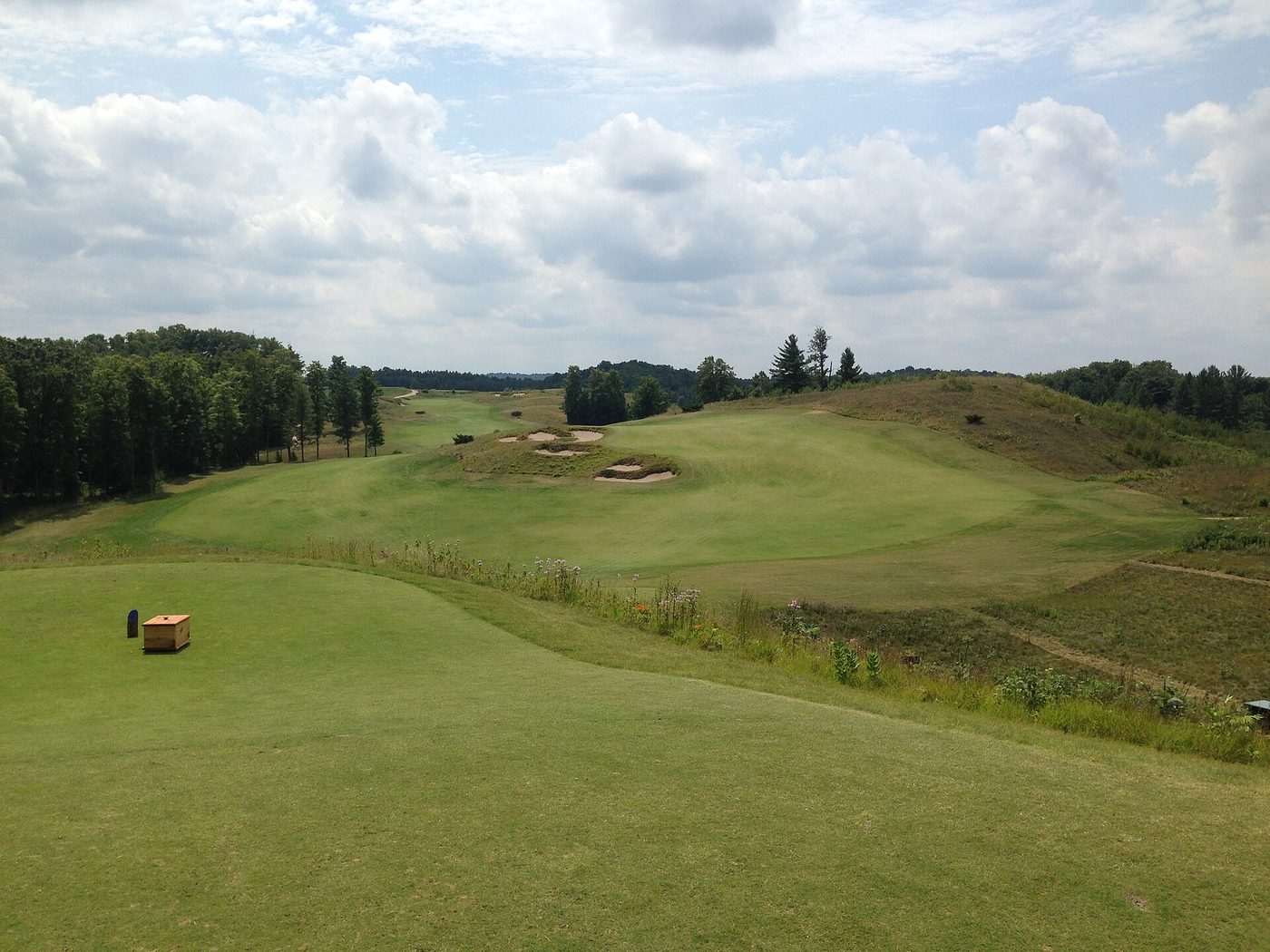
The fairway is the closely mown strip of grass that runs from the teeing area toward the green on most par 4s and par 5s. It’s the target for your tee shot, because the short grass gives a clean lie and the most control over your next shot.
Fairways are part of the general area in the Rules, so there are no special rules for them, but they’re where the architect does the most to shape how a hole plays. A fairway can be wide or narrow, straight or bent around a corner (a dogleg), tilted, crowned or split by bunkers. Fairway widths vary enormously: modern courses built for firm, fast play, such as Kapalua’s Plantation Course on Maui, have fairways 60 or 70 yards wide, while a tight, tree-lined parkland course may give you 25.
What it means for your game. Not all of the fairway is equal. On a dogleg, the inside of the corner shortens the hole but often brings trouble into play; the outside is safer but longer. Many great holes reward the golfer who places the tee shot on one side of the fairway with a better angle into the green.
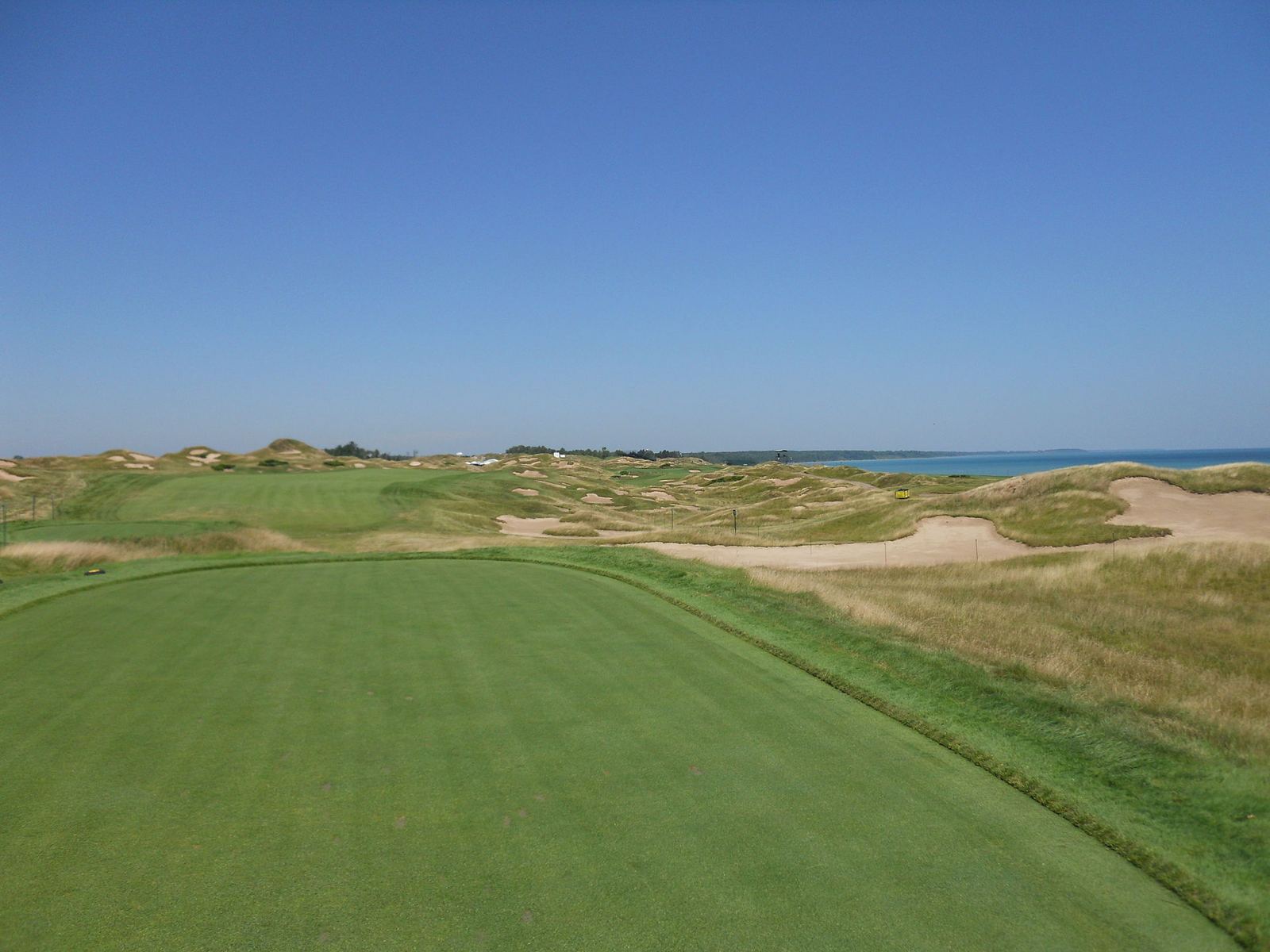
Famous example. At Whistling Straits in Wisconsin, Pete Dye framed the fairways with man-made dunes, fescue and bunkers, so the short grass looks like a green ribbon through rough country. Miss it and you’re in sand or long grass; hit it and the holes are very playable.
The rough, the first cut and the fringe
The rough is the longer grass beside the fairway and around the green. It makes the next shot harder, because grass gets between the club and ball. Many courses have a “first cut” of intermediate grass between fairway and rough, and a short collar, called the fringe or apron, around each green.
Rough. The length and thickness of rough vary with the course and the season. At a U.S. Open, rough can be four or five inches deep; at a resort course, it may be barely longer than the fairway. Bermudagrass rough in the South grabs the club; cool-season rough in the North can be thick and wet. The Rules don’t treat it differently from the fairway, but your ball will.
The first cut. A strip of grass a little longer than the fairway, it softens the penalty for a slightly missed shot.
The fringe, collar or apron. The short grass ringing the green is part of the general area, not the putting green. So you can’t mark and lift your ball there, but you can almost always putt from it, and you usually should.
What it means for your game. Out of heavy rough, take a more lofted club and get back to the fairway. The biggest scoring mistake high handicappers make is trying a hero shot from thick grass.
Famous example. Augusta National has no rough in the usual sense. The longer grass beside its fairways is called the “second cut”, and it’s kept short enough to play from. What makes Augusta hard is the slopes, the pine straw under the trees and the greens.
The general area: trees, paths and everything else
The general area covers the whole course except the teeing area you’re playing from, the green you’re playing to, bunkers and penalty areas. It includes fairways, rough, trees, cart paths and the tees and greens of other holes. You play the ball as it lies here, with free relief from certain conditions.
Inside the general area, you’ll find a few things the Rules treat specially:
- Immovable obstructions, such as cart paths, sprinkler heads, drainage covers and shelters. If one interferes with your stance or swing, you can take free relief: find the nearest point where it no longer interferes and drop within one club-length, no nearer the hole.
- Abnormal course conditions, including ground under repair (often marked with white lines or blue stakes), temporary water (puddles) and animal holes. Free relief applies here too.
- Movable obstructions, such as rakes, bottles and signs. Move them.
- Loose impediments, such as leaves, twigs and stones. You can remove them anywhere, as long as your ball doesn’t move.
- Wrong greens. If your ball is on the putting green of another hole, you must take free relief off it.
What it means for your game. Know your free relief. Golfers regularly take penalty drops or play off a cart path when they’re entitled to free relief under the Rules.
Bunkers
A bunker is a prepared area of sand, usually in a hollow, built as a hazard. Under the Rules of Golf, you can’t touch the sand with your club immediately in front of or behind the ball, in a practice swing or on your backswing. Grass-covered areas and the bunker’s edges aren’t part of the bunker.
Bunkers are the most distinctive part of most golf courses. They guide the eye, protect greens, catch drives and give each course its look. There are two main kinds:
- Fairway bunkers, beside or across the landing area, which punish a missed tee shot. From a fairway bunker, the priority is to get out cleanly; take a club that will clear the lip.
- Greenside bunkers, around the green, which call for a splash shot, with the club entering the sand behind the ball.
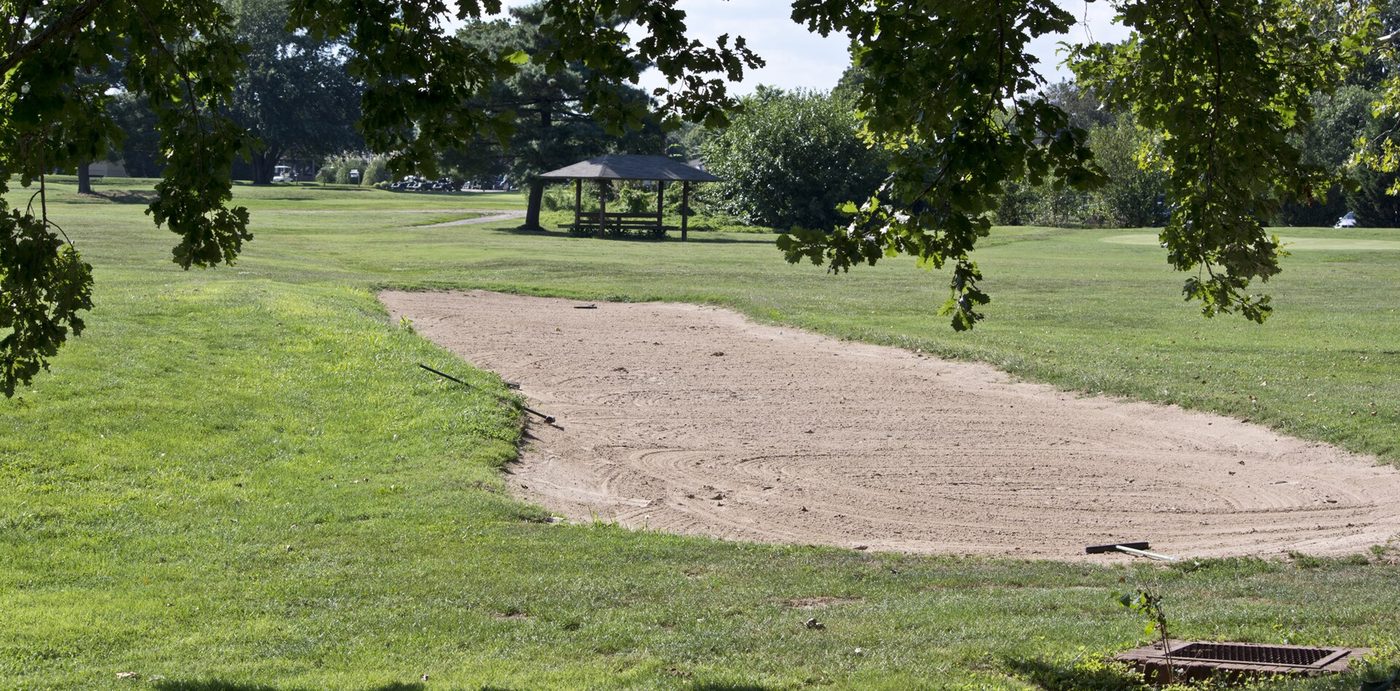
What the Rules allow. Since 2019, you can remove loose impediments, such as leaves and stones, from a bunker, and touch the sand with your hand or club generally, as long as you’re not testing the conditions or touching the area right around the ball. If your ball is unplayable in a bunker, you have the usual one-stroke options inside the bunker, plus a two-stroke option to drop outside it, back on the line from the hole.
What it means for your game. Always rake your footprints and the mark your shot left when you leave. Our guide to golf etiquette explains how.
Famous examples. Oakmont Country Club near Pittsburgh has the Church Pews, a huge bunker between the 3rd and 4th fairways striped with grass ridges that look like rows of pews. At Whistling Straits, Pete Dye built roughly a thousand bunkers by the usual count, and under the course’s local rule every sandy area is played as a bunker. Dustin Johnson found that out at the 2010 PGA Championship, when he grounded his club in one on the final hole and was penalised two strokes.
Penalty areas (formerly water hazards)
A penalty area is a body of water, such as a lake, pond, creek or the sea, or any other area a course marks with red or yellow stakes or lines. You can play your ball as it lies without penalty, or take relief for one stroke. Red penalty areas give an extra sideways relief option; yellow ones don’t.
Until 2019, the Rules called these “water hazards” and “lateral water hazards”. The modern name reflects that a course can mark desert, jungle, lava or steep ravines as penalty areas too, which is common in Arizona, Hawaii and on mountain courses.
Your options. If your ball is in a penalty area, you can:
- Play it as it lies, with no penalty. You can ground your club and remove loose impediments.
- Take stroke-and-distance relief for one stroke, playing again from where you last hit.
- Take back-on-the-line relief for one stroke, dropping on a line from the hole through the point where your ball last crossed into the penalty area, as far back as you like.
- For red penalty areas only, take lateral relief for one stroke, dropping within two club-lengths of where the ball last crossed the edge, no nearer the hole.
What it means for your game. Know which colour you’re dealing with before you hit, and when in doubt, play away from red and yellow stakes. The lateral option on red areas saves a lot of strokes.
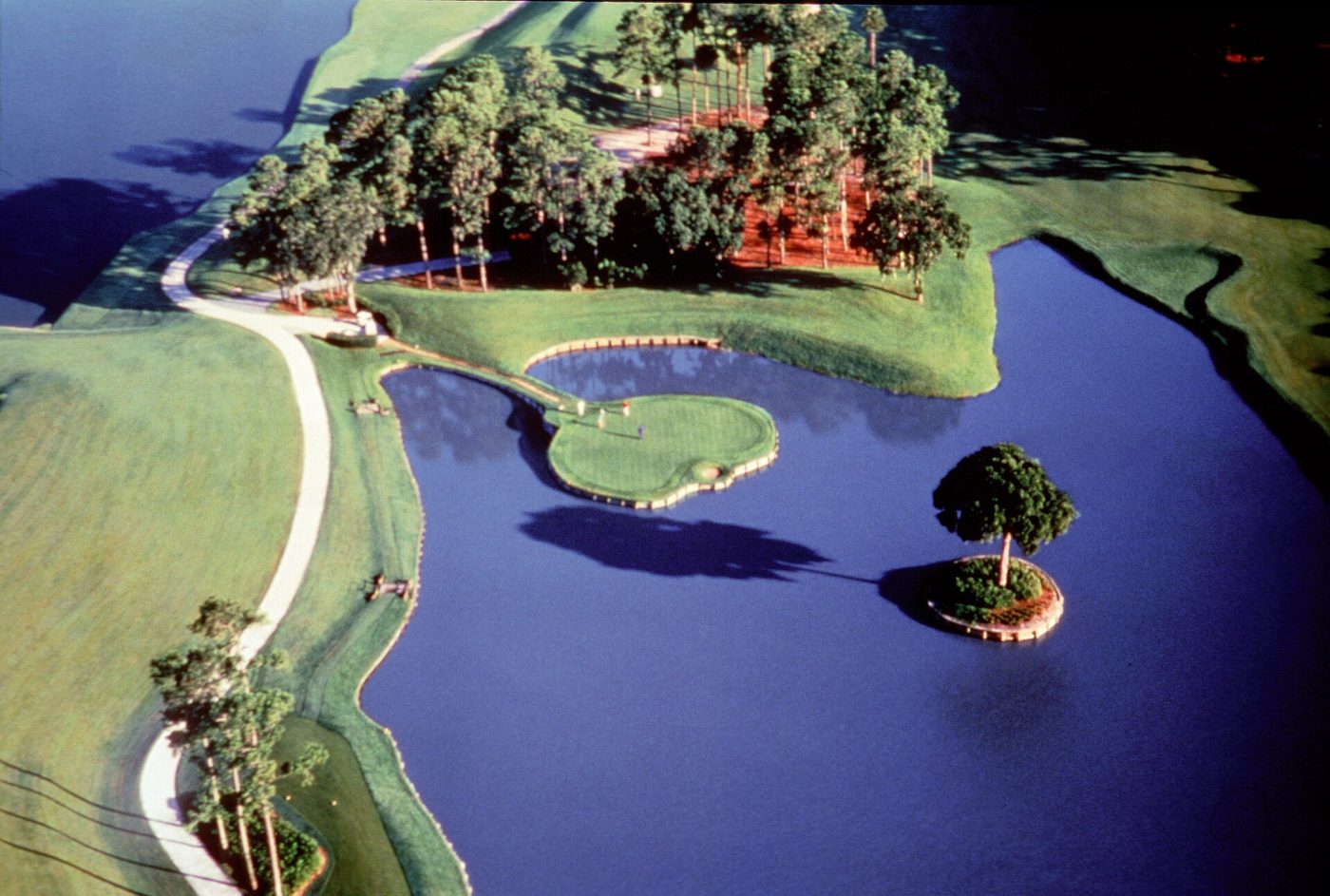
Famous example. The 17th on the Stadium Course at TPC Sawgrass is the most famous penalty area in golf: a short par 3 to a green surrounded by water on all sides but a narrow walkway. Miss the green and you’re in the lake. The public can play it, from $550 in summer to $775 the rest of the year, with a cart, forecaddie and range balls included. Our guide to golf course hazards explains bunkers, water and the other features architects use.
The putting green
The putting green is the specially prepared area of very short grass around the hole on the hole you’re playing. On the green, you can mark, lift and clean your ball, repair almost any damage, including spike marks, and putt with the flagstick in or out.
Greens are the most carefully maintained, most expensive and most important part of a golf course. They’re mown very low, often to about an eighth of an inch or less, rolled and cut in different patterns, and they’re where half of a typical golfer’s strokes are played.
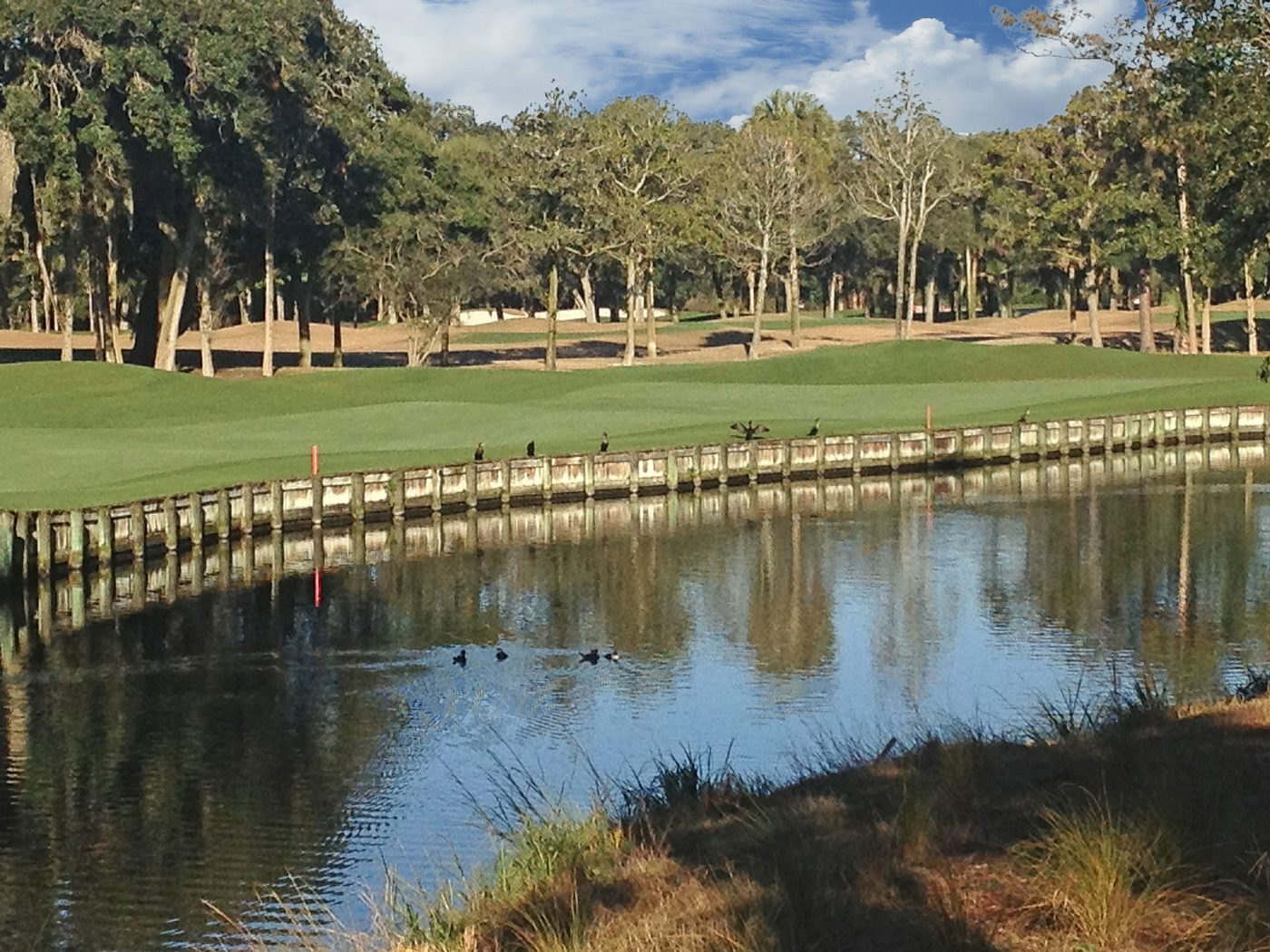
The hole and flagstick. Under the Rules of Golf, the hole is 4.25 inches (108 mm) in diameter and at least 4 inches (101.6 mm) deep, and a flagstick marks its position. The hole is moved regularly, usually daily at busy courses, to spread wear and change how the green plays. Since 2019, there’s no penalty if your putt from the green hits the flagstick.
Grass types. Greens are usually bentgrass or poa annua in cooler climates and bermudagrass or seashore paspalum in the South and the tropics. Bermuda and paspalum greens have more grain, meaning putts are affected by the direction the grass grows. Our guide to golf course grass explains how each plays.
What it means for your game. Read the slope from below the hole, check the grain on warm-climate greens and repair your ball mark every time.
Famous examples. Pinehurst No. 2 in North Carolina is famous for its crowned, or “turtleback”, greens, which fall away on every side into short grass, so a slightly missed approach rolls off and leaves a tricky chip or putt. Merion Golf Club in Pennsylvania uses wicker baskets on top of its flagsticks instead of flags, so golfers can’t read the wind from them. And the Old Course at St Andrews in Scotland has seven double greens, shared by two holes going in opposite directions.
Out of bounds and the edges of the course
Out of bounds is any area outside the boundary of the course, usually marked by white stakes, white lines or a fence. A ball that lands out of bounds must be replayed under stroke and distance: one penalty stroke, and you hit again from where you last played.
Stroke and distance. If your tee shot goes out of bounds, you add a penalty stroke and play again from the tee, so your next shot is your third. That’s why golfers hit a provisional ball when they think the first may be out of bounds or lost.
The local rule alternative. Many courses adopt a USGA local rule (Model Local Rule E-5) that lets casual golfers drop near where the ball went out of bounds or was lost, in the fairway if they like, for two penalty strokes, rather than walking back to the tee. It isn’t used in elite competitions, but it speeds up everyday play. Check the scorecard or ask the starter.
What it means for your game. On a hole with out of bounds close on one side, aim at the other half of the fairway and accept a longer approach.
How is par set for each hole?
Par is the score an expert golfer is expected to make on a hole, set mainly by its length from the tees. The USGA’s guidelines put par 3s at up to 260 yards for men and 220 for women, par 4s at 240 to 490 yards (200 to 420 for women) and par 5s at 450 to 710 yards (370 to 600).
Here are the USGA’s par guidelines from Appendix F of the Rules of Handicapping:
| Par | Men (yards) | Women (yards) |
|---|---|---|
| 3 | Up to 260 | Up to 220 |
| 4 | 240 to 490 | 200 to 420 |
| 5 | 450 to 710 | 370 to 600 |
| 6 | 670 and over | 570 and over |
Source: USGA Rules of Handicapping, Appendix F, Establishing Par.
The ranges overlap because length isn’t the only factor. A course can set par higher or lower for a hole that plays sharply uphill or downhill, into the prevailing wind or around a severe dogleg. That’s why a 480-yard hole can be a par 4 at one course and a par 5 at another.
Most 18-hole courses add up to a par of 70, 71 or 72, usually with four par 3s, four par 5s and ten par 4s for a par 72. Major championship venues often play as par 70 or 71 by turning shorter par 5s into long par 4s. Our guide to what par means in golf goes into how par, course rating and slope relate, and our guide to course rating and slope rating explains the numbers on the scorecard. To turn your Handicap Index into strokes on a particular set of tees, use our course handicap calculator.
Hole design: doglegs, forced carries and template holes
Every hole is a combination of the parts above, and architects arrange them in patterns that recur on courses all over the world.
- Dogleg: a hole that bends left or right, like a dog’s hind leg. The corner is usually the key decision point.
- Forced carry: a shot that must fly over water, sand, desert or a ravine to reach the fairway or green, common on desert and coastal courses.
- Risk-reward hole: a hole, often a short par 4 or par 5, that offers a big reward for a bold shot and a big penalty for failure.
- Redan: a par 3 whose green angles away from the golfer, from front right to back left, with a bunker guarding the front left. Named after the 15th at North Berwick in Scotland and copied at courses such as the National Golf Links of America.
- Biarritz: a green split by a deep swale across the middle.
- Punchbowl: a green set in a hollow, so slopes feed the ball toward the middle.
- Island or peninsula green: a green surrounded, or nearly surrounded, by water, such as the 17th at TPC Sawgrass.
These “template holes” were popularised in America by Charles Blair Macdonald and Seth Raynor in the early 20th century. We explain them in detail, with diagrams and examples, in our guide to golf hole design features.
How do 18 holes fit together?
A standard golf course has 18 holes split into two nines: the front nine (holes 1 to 9) and the back nine (10 to 18). On most modern courses, both nines start and finish near the clubhouse; on traditional links, the front nine often goes out and the back nine comes home along the coast.
The routing. The way the architect arranges the holes across the land is called the routing, and it’s the most important decision in golf course design. A good routing uses the best natural features for greens and tees, changes direction often so the wind affects every club, and keeps walks between greens and tees short.
Returning nines. Most American courses have “returning nines”, with the 9th green and 10th tee near the clubhouse, so golfers can stop after nine holes and the course can start groups on both the 1st and 10th tees.
Out and back. Classic links courses such as the Old Course at St Andrews go out along the shore and come back, so the wind blows one way on the front nine and the other on the back.
Types of course. Courses also differ by setting: links, parkland, heathland, desert, mountain and resort courses each use the same parts in very different ways. We cover those in our guide to types of golf courses and our explainer on what a links golf course is.
The rest of the course: practice areas, clubhouse and starter
Beyond the 18 holes, most courses have a set of facilities you’ll use before and after your round:
- The practice range (driving range): a large field for hitting full shots, usually with mats or grass tees.
- The practice putting green: near the first tee and clubhouse, for warming up your putting.
- The short-game area: a practice green with a bunker and rough for chipping and pitching.
- The pro shop: where you check in, pay and buy balls and equipment.
- The starter’s hut: by the first tee, where the starter sends groups off.
- The clubhouse: locker rooms, a restaurant and bar (the “19th hole”).
- The cart barn and bag drop: where carts are kept and bags are loaded.
Our guide to how to book a tee time explains what happens at check-in.
How big is a golf course?
A regulation 18-hole golf course usually covers about 120 to 200 acres, according to the American Society of Golf Course Architects. An executive course, made mostly of par 3s and short par 4s, needs about 75 to 100 acres, and an 18-hole par-3 course about 30 acres.
| Type of course | Typical size (ASGCA) | Typical length |
|---|---|---|
| 18-hole par-3 course | About 30 acres | Under 3,000 yards |
| Executive course | About 75 to 100 acres | About 3,500 to 5,000 yards |
| Regulation 18-hole course | About 120 to 200 acres | About 6,000 to 7,500 yards from the back tees |
Acreage from the American Society of Golf Course Architects. Yardages are typical ranges, not ASGCA figures.
Courses in housing developments, on rugged land or with big practice facilities can be much larger. Desert target courses use fewer irrigated acres, because only the playing corridors are grassed. We explain the numbers in our guide to how big a golf course is, and the economics in our guide to the cost to build a golf course. For the national picture, see how many golf courses there are in the US.
How to read a hole from the tee
Putting the parts together is what good course management is. Before every tee shot, run through this list:
- Check the hole on the card or the tee sign: par, yardage, and any stroke index.
- Find the green, even if you can’t see it, and note where the flag is today.
- Identify the trouble: out of bounds (white), penalty areas (red or yellow), bunkers and heavy rough.
- Pick the side of the fairway that gives the best angle into the green and keeps you away from the worst trouble.
- Choose the club that reaches that spot, not the one that goes farthest.
- Tee up on the side of the teeing area that lets you aim away from the trouble.
- Plan the approach: where is the safe miss around the green? Usually it’s away from bunkers and water, toward the widest part.
Common mistakes about the parts of a golf course
- Thinking the fringe is part of the green. It isn’t; you can’t mark and lift your ball there.
- Grounding the club in a bunker. It’s a two-stroke penalty in stroke play if you touch the sand right around the ball or in your backswing.
- Not knowing red from yellow. Red penalty areas allow lateral relief; yellow ones don’t.
- Playing off cart paths. You’re entitled to free relief from immovable obstructions.
- Not hitting a provisional ball. If the first might be out of bounds or lost, a provisional saves a walk back.
- Playing the wrong tees. The longest set rarely matches most golfers’ distances.
- Leaving ball marks and footprints. Repair the green and rake bunkers every time.
Frequently asked questions
What are the 5 areas of a golf course?
The Rules of Golf define five areas: the teeing area of the hole you’re playing, the general area, bunkers, penalty areas and the putting green of the hole you’re playing. The general area covers everything that isn’t one of the other four, including fairways, rough and trees.
What is the tee box called in golf?
The Rules of Golf call it the teeing area. It’s a rectangle two club-lengths deep, starting at a line between the front edges of the two tee markers. Golfers commonly say tee box, tee or tee ground.
What is the short grass around the green called?
It’s called the fringe, collar or apron. It’s part of the general area, not the putting green, so you can’t mark and lift your ball there. Most golfers putt from the fringe when the grass is short enough.
What is the difference between a bunker and a penalty area?
A bunker is a prepared area of sand, and you play from it without penalty but can’t touch the sand around the ball before your stroke. A penalty area is water or another area marked red or yellow; you can play from it or take relief for a one-stroke penalty.
How big is the hole on a golf green?
The hole is 4.25 inches (108 mm) in diameter and at least 4 inches (101.6 mm) deep, according to the Rules of Golf. The flagstick marks its position, and courses usually move the hole daily to spread wear.
How many acres is a golf course?
A regulation 18-hole course usually covers about 120 to 200 acres, according to the American Society of Golf Course Architects. An executive course takes about 75 to 100 acres and an 18-hole par-3 course about 30 acres.
What do white, red and yellow stakes mean on a golf course?
White stakes or lines mark out of bounds, where a ball must be replayed under stroke and distance. Red stakes mark penalty areas with a lateral relief option; yellow stakes mark penalty areas without it. Blue stakes often mark ground under repair, where relief is free.
What is the rough in golf?
The rough is the longer grass beside the fairway and around the green. It makes the next shot harder because grass gets between the club and ball. Its length varies from barely longer than the fairway at a resort to several inches at a U.S. Open.
Our verdict
Every golf course, from a nine-hole muni to Pebble Beach, is built from the same few parts: a teeing area, a fairway and rough, bunkers and penalty areas, and a green. What makes one course great and another forgettable is how those parts are arranged, and what makes one golfer score better than another is often simply knowing what each part asks of them.
So learn the five areas, know your free relief, pick the side of the fairway before you pick the club, and play the tees that fit your game. Then, when you get the chance to see an island green, a Church Pews bunker or a turtleback green in person, you’ll know exactly what the architect was trying to do. For more on the people who design those features, see our guide to the great golf course architects.
Sources
- Rules of Golf, USGA
- Appendix F: Establishing Par, USGA Rules of Handicapping
- Position Paper on Par, USGA
- What exactly are Course Rating and Slope Rating?, USGA
- American Society of Golf Course Architects, American Society of Golf Course Architects
- The five areas of the golf course explained, Arizona Golf Association
- FAQ, TPC Sawgrass
- Golf price list, Bethpage State Park
Image credits
| Image | Photographer | Licence | Source |
|---|---|---|---|
| Putting green and bunkers from the air, Royal Canberra Golf Club (featured image) | Neuroxic | CC BY 4.0 | Wikimedia Commons |
| Teeing area with tee markers | PattayaPatrol | CC BY-SA 4.0 | Wikimedia Commons |
| Bunker on the White Course, East Potomac Golf Course | Tim Evanson | CC BY-SA 2.0 | Wikimedia Commons |
| Kingsley Club, first tee | Ben Scripps | CC BY-SA 4.0 | Wikimedia Commons |
| Whistling Straits, 11th fairway | User:KevinTR | public domain | Wikimedia Commons |
| TPC Sawgrass, 17th hole | Unknown photographer | public domain | Wikimedia Commons |
| Kiawah Island Golf Resort, bulkhead green | Bill Showalter from Greeneville Tennessee, USA | CC BY 2.0 | Wikimedia Commons |