
Winter rules golf means playing under the preferred lies Local Rule, Model Local Rule E-3 in the Rules of Golf. It lets you mark, lift, clean and place your ball within a set distance, such as a scorecard’s length, when it lies on closely mown grass. Only the course’s committee can put it into effect, and only on the terms it posts.
That last part is where most golfers go wrong. “Winter rules” in a lot of casual groups means nudging the ball onto a better tuft wherever it lies, with the clubhead, all year round. That isn’t winter rules; it’s just improving your lie. The real Local Rule is narrower, more precise and, used properly, entirely legitimate: tour events use it on soggy fairways, and so do thousands of clubs every winter. For the wider code of behaviour on the course, start with our guide to golf etiquette.
This guide explains what the preferred lies Local Rule actually says, how to take relief properly step by step, when courses use it in the United States, whether those scores count for your handicap, how winter affects posting in the 41 US golf associations with an inactive season, and the other Rules that come up in cold, wet weather: embedded balls, temporary water, snow, ice and frost.
How we built this. The Local Rule text comes from the Rules of Golf’s Model Local Rule E-3, as published by golf associations and explained by the Washington Golf and Florida State Golf associations. Handicap guidance comes from the USGA’s Rules of Handicapping and from state associations, including the Oregon Golf Association and Washington Golf. We’ve kept to what the Rules and the associations say; where your club’s own Local Rule differs, your club’s version is the one that applies.
At a glance
- What winter rules are: the preferred lies Local Rule, Model Local Rule E-3, adopted by a course’s committee when conditions warrant
- Where they apply: only when your ball touches part of the general area cut to fairway height or less, unless the committee specifies otherwise
- What you can do: mark the spot, lift and clean the ball, and place it once within the relief area the committee sets, such as 6 inches, a scorecard’s length or a club-length, no nearer the hole
- What you can’t do: roll the ball with your club, use it in the rough or in bunkers, or place it twice
- Handicap: scores under preferred lies must be posted in the active season unless the handicap committee suspends posting
- Winter posting: 41 US golf associations have an inactive season; in Washington Golf’s territory it runs from November 15 to March 1
- Frost: you can’t remove it, and walking on frozen turf damages it, which is why courses hold frost delays
What is winter rules golf?
Winter rules golf is golf played under the preferred lies Local Rule, which lets a player whose ball lies on closely mown grass mark it, lift it, clean it and place it once within a specified distance, no nearer the hole. Courses adopt it when wet or worn turf would leave unfair lies.
The name comes from Britain and Ireland, where clubs have traditionally used preferred lies through the wet months; British golf media describe a typical season of roughly October to April. In the United States you’ll also hear it called “lift, clean and place”, which is how the professional tours announce the same Local Rule when heavy rain has soaked the fairways. The Rules of Golf themselves call it preferred lies.
Whatever the name, it exists because the normal Rules don’t give you relief from mud on your ball or a bare, soggy patch of fairway. Under the standard Rules, you play the ball as it lies, mud and all. In good conditions that’s fair. In a wet winter, when fairways are soft, muddy and thin, a committee can decide that playing the ball down produces lies that are unfair and damages the turf further, and preferred lies fixes both problems.

What the preferred lies Local Rule actually says
Model Local Rule E-3 is a template that committees adopt and fill in. Its core is simple: when any part of a player’s ball touches part of the general area cut to fairway height or less, the player may take free relief once by placing the original ball, or another ball, in a relief area and playing it from there.
The committee fills in the details, and the details matter:
| What the committee decides | Common choices | What it means for you |
|---|---|---|
| Where the Local Rule applies | Areas of the general area cut to fairway height or less; sometimes only the fairway of the hole being played | If your ball is in the rough, the Local Rule doesn’t help you |
| Size of the relief area | 6 inches, the length of a scorecard, or one club-length | How far you may move the ball from its original spot |
| Limits | Not nearer the hole, and in the general area; often also on fairway-height grass | You can’t move the ball closer to the hole, into the rough or onto a green |
| How often | Once per shot | Once you’ve placed the ball, it’s in play; you can’t pick it up and try again |
The relief-area choice changes the game more than golfers expect. Six inches gets you off a mud patch; a club-length can take you from a bare lie to a perfect one almost anywhere on the fairway. If a course hasn’t specified, ask; don’t assume.
A few details trip people up:
- You must mark the spot first. The original spot is the reference point for the relief area, so mark it before you lift.
- You place the ball; you don’t drop it or roll it. Moving the ball with the clubhead isn’t part of the Local Rule.
- You may substitute another ball. The Local Rule allows the original ball or another ball.
- Playing from the wrong place costs the general penalty: two strokes in stroke play or loss of the hole in match play.
Many committees settle on a scorecard’s length, which is a sensible middle ground: enough to get off mud, not enough to rebuild your lie.
How to take preferred lies, step by step
- Check that the Local Rule is in effect. Look at the notice board, the starter’s sheet, the scorecard or the club’s website. If nobody has adopted it, you play the ball as it lies.
- Check where your ball is. It must be touching part of the general area cut to fairway height or less, or whatever area the committee has specified. Not the rough, not a bunker, not a penalty area, not the putting green.
- Mark the spot. Put a tee or ball-marker right behind the ball before you touch it.
- Lift and clean the ball. Wipe off the mud; this is the main point of the rule.
- Work out the relief area. Measure the distance the committee has set, such as a scorecard’s length, from the marked spot, no nearer the hole and within any other limits.
- Place the ball. Choose a spot in the relief area and set the ball down by hand. Don’t drop it, and don’t roll it into position with your club.
- Play it. Once placed, the ball is in play. You can’t lift it again under the same Local Rule for that shot.
The whole thing should take ten seconds. If your group is spending a minute on every fairway shot finding the perfect blade of grass, you’re slowing the course down, and in winter, with short days, that matters.
When do courses use winter rules?
Whenever the committee decides conditions justify it, which usually means soft, wet or thin fairways. In Britain, clubs typically use preferred lies from about October to April; in the United States, courses adopt them after heavy rain, during spring green-up and on dormant or recovering turf, at any time of year.
There’s no national winter rules season in the United States, because the country has too many climates. A course in Seattle might use preferred lies for much of the winter; a course in Phoenix might never need them, because its overseeded fairways are dry and firm; a course in Atlanta might adopt them for a week after a storm in July. The test is the condition of the turf, not the calendar.
Here’s where you’re most likely to meet them:
- Wet climates in winter. The Pacific Northwest, the mid-Atlantic and the Southeast’s clay-soil courses, when fairways are soft and muddy for weeks.
- After heavy rain anywhere. Many courses adopt preferred lies for a few days after a big storm, then withdraw them once the fairways firm up.
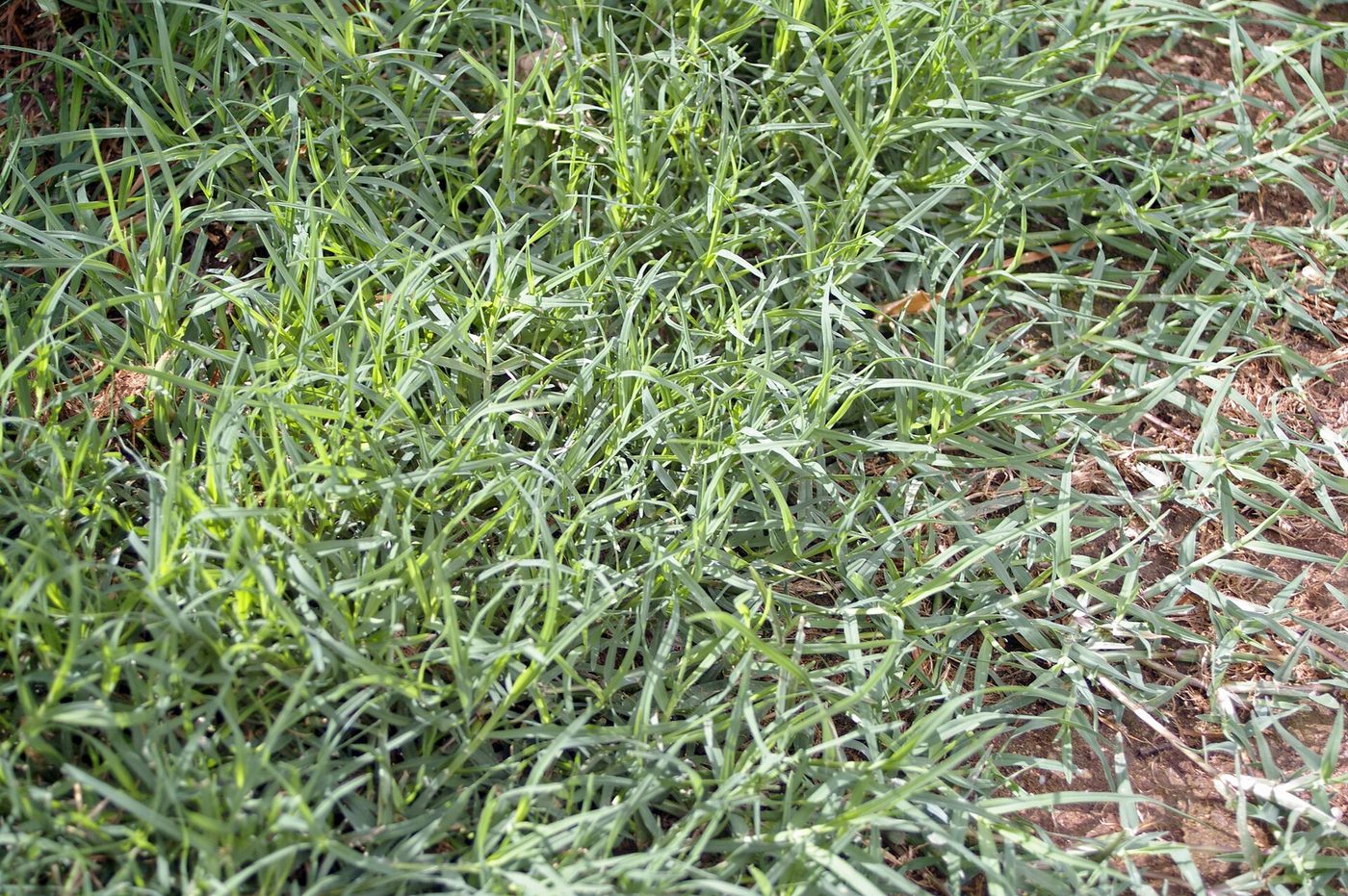
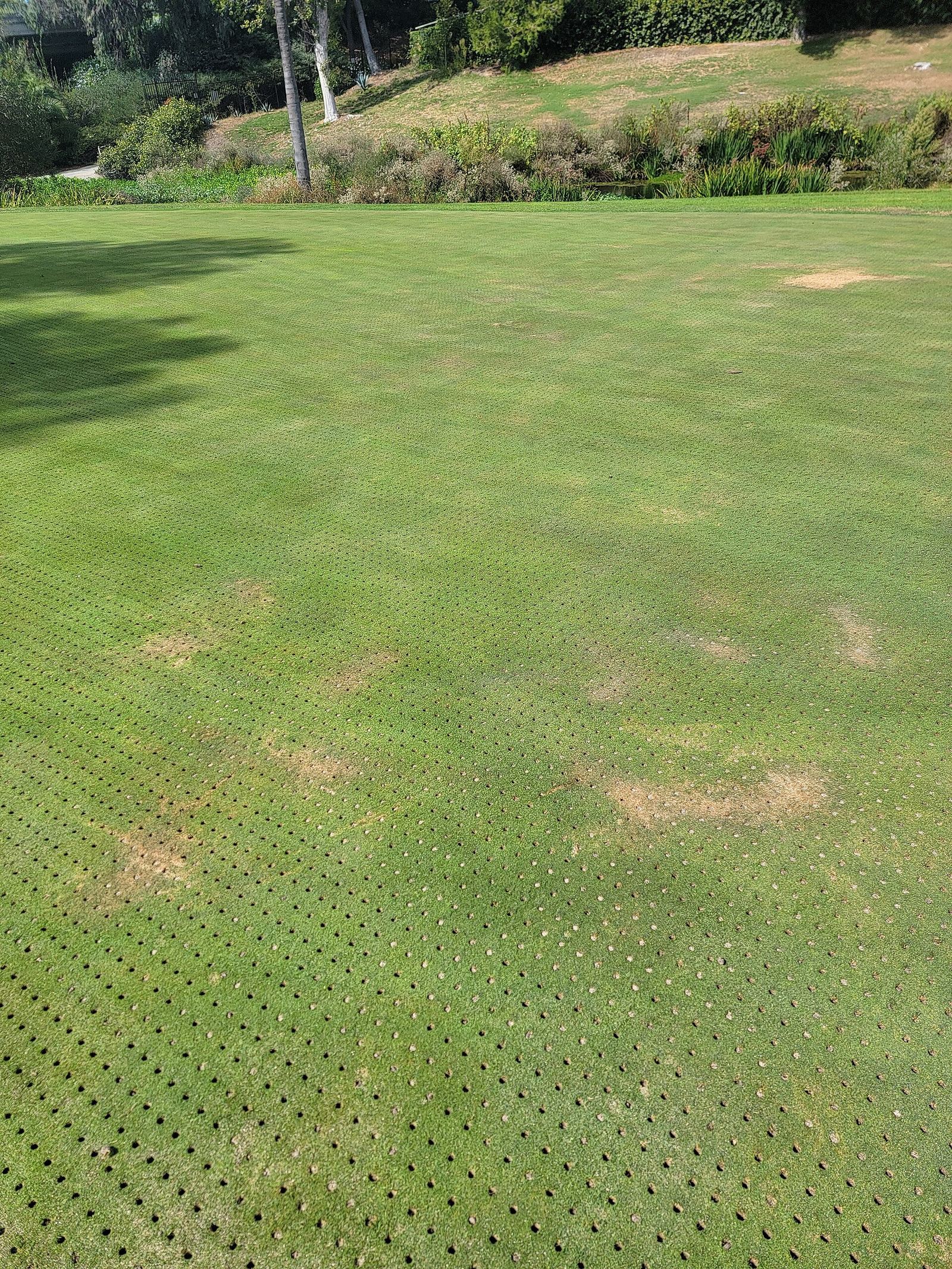
- Dormant or recovering turf. Southern courses with dormant bermudagrass fairways, or courses recovering from overseeding or aeration, sometimes use preferred lies while the grass is thin. Our guides to why golf courses aerate greens and how overseeding works explain those seasonal disruptions.
- Spring thaw in the North. When courses reopen after winter, soft fairways often justify a few weeks of preferred lies.
- Professional events. Tours adopt “lift, clean and place” when rain has soaked the fairways, and the same Local Rule is what your club uses.
Do winter rules scores count for your handicap?
Yes, in the United States, as long as you’re in the active season. Scores made while the preferred lies Local Rule is in effect must be posted, unless the club’s handicap committee, in consultation with the golf association, decides conditions are so poor that posting should be suspended.
That’s a change from what many golfers assume. Preferred lies don’t make a round “unofficial”. The World Handicap System treats them as a legitimate Local Rule, and the course rating doesn’t change. What can stop scores from counting is the calendar, or temporary course changes.
The inactive season. The USGA’s Rules of Handicapping allow each regional golf association to set an inactive season, when scores aren’t posted. According to guidance published by Washington Golf and the USGA, 41 golf associations in the United States have an inactive posting season during the winter; in Washington Golf’s territory it runs from November 15 to March 1. Whether to post depends on where you play, not where your home club is. If you live in an inactive-season state but spend February in Arizona or Florida, where the season is active, you post those scores. The USGA publishes each association’s schedule.
Temporary greens and tees. When a course uses temporary greens or tees and no temporary course rating has been issued, the USGA’s Rules of Handicapping say to record net par on each hole where they’re in use. At least 7 holes must be played on permanent tees and greens for a 9-hole score to be acceptable, and at least 14 holes for an 18-hole score.
| Situation | Post the score? | Source |
|---|---|---|
| Preferred lies in effect, active season | Yes, unless the handicap committee suspends posting | USGA guidance via the Oregon Golf Association |
| Inactive season where you played | No | Your regional golf association’s schedule |
| Playing in an active-season area while your home area is inactive | Yes | USGA |
| Temporary greens or tees, no temporary rating | Yes, with net par on the affected holes, if at least 14 of 18 holes were normal | USGA Rules of Handicapping |
| Your group’s own “winter rules” not adopted by the course | Not as a legitimate score under the Rules | The Rules of Golf |
Winter rules in casual golf: what’s fair
Plenty of weekend groups play their own version of winter rules, and in a casual round among friends that’s their business. But if you’re going to do it, do it fairly, and if you’re posting the score, do it properly.
- Agree before the first tee. Decide whether you’re playing preferred lies, how far you can move the ball and where it applies. Changing the rules on the 7th fairway because you’ve drawn a bad lie isn’t winter rules.
- Fairway only. The Local Rule covers closely mown areas. Moving the ball in the rough, around trees or in a bunker isn’t what the Local Rule is designed for, and committees don’t allow it.
- Place, don’t roll. Mark, lift and place by hand. Nudging the ball forward with the clubhead is how a scorecard length quietly becomes a yard.
- Same rule for everyone. If one player’s playing it down and another’s lifting and placing, the match isn’t a match.
- If you post the score, follow the course’s rule. Your handicap is only as good as the scores in it.
The quiet truth is that most golfers would play better, and enjoy winter golf more, if they used preferred lies exactly as written. The relief is real, the rule is clear, and nobody can argue about it in the bar afterwards.
Other Rules you’ll use in winter
Preferred lies isn’t the only Rule that matters in cold, wet weather. Several standard Rules give relief without any Local Rule at all:
- Embedded ball. If your ball is embedded in its own pitch-mark anywhere in the general area, you get free relief under Rule 16.3, except when it’s embedded in sand in a part of the general area not cut to fairway height or less. No Local Rule is needed.
- Temporary water. What golfers used to call casual water. If your ball, stance or swing is affected by temporary water in the general area, you get free relief under Rule 16.1.
- Snow and natural ice. You may treat snow and natural ice either as loose impediments, which you can remove, or as temporary water, which gives you relief. It’s your choice.
- Frost. Frost is different. It’s neither a loose impediment nor temporary water, and you’re not allowed to remove it to improve the conditions for your stroke.
- Aeration holes. If the committee has adopted Model Local Rule E-4, you get relief when your ball lies in or touches an aeration hole; otherwise you don’t. Autumn aeration often overlaps the start of winter rules, so check for both.
- Ground under repair. Committees often mark damaged or recovering areas in winter. Relief from ground under repair is free under Rule 16.1.
Frost delays, cart rules and other winter conditions
Winter golf brings conditions the Rules don’t cover, and courses manage them with policies rather than Local Rules.
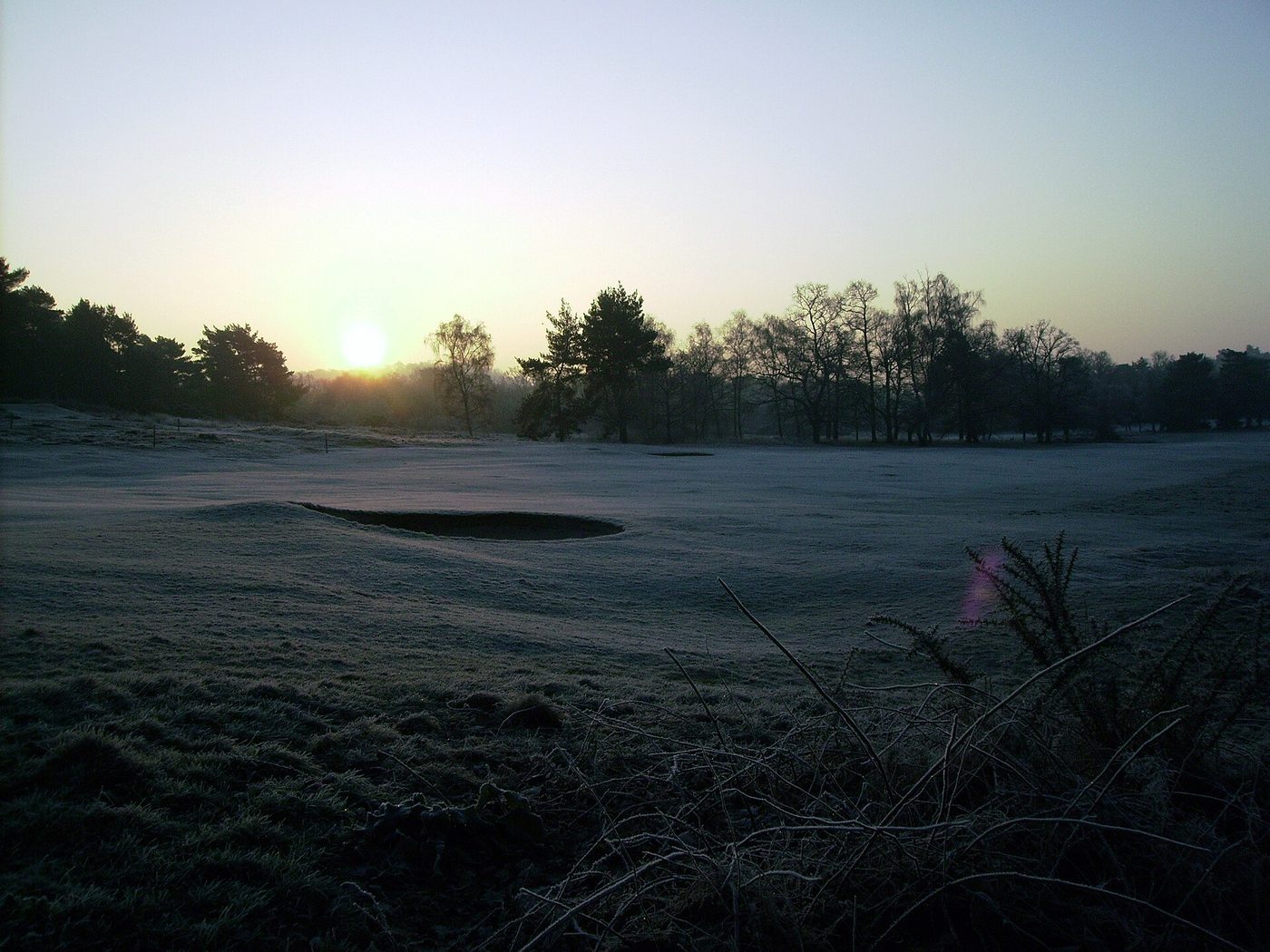
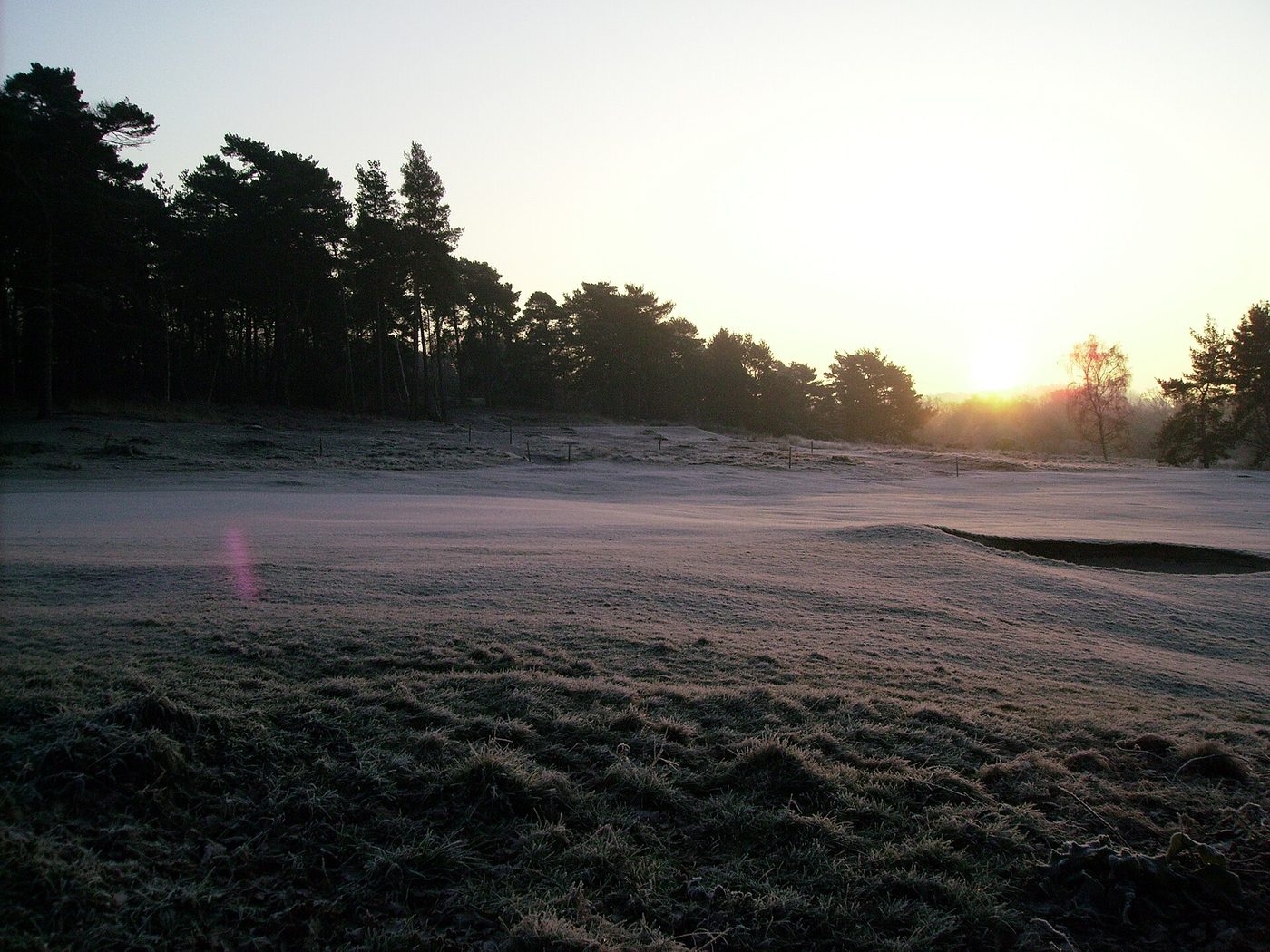
Frost delays. Frozen grass blades break when they’re walked on or driven over, and the damage shows up later as dead, brown footprints. That’s why courses delay tee times until the frost has melted, and why the first tee time on a cold morning can move back an hour or more. On a frosty December morning like this one at Reigate Heath in England, nobody should be on the greens until the sun has done its work.
Cart-path-only. Wet fairways rut under cart tyres, so courses restrict carts to the paths. Expect a longer round and more walking, and take two or three clubs from the cart each time.
Temporary greens and tees. Some northern courses move to temporary greens in deep winter to protect the real ones. Remember the handicap rule above: if more than four holes of 18 are on temporary greens or tees, the score isn’t acceptable unless a temporary rating has been issued.
Fairway mats. In Britain and Ireland, many clubs require players to hit fairway shots from small mats in winter. It’s rare in the United States, but if you’re playing abroad, ask before you go.
For how frost delays and winter conditions affect your tee time, see our guide on how to book a tee time, and for what to wear when it’s cold, our guide to golf course dress codes covers what most clubs allow.
Mistakes golfers make with winter rules
- Assuming winter rules are on because it’s winter. Only the committee can adopt them, and many courses don’t.
- Using them in the rough. The Local Rule covers closely mown areas, not the whole course.
- Rolling the ball with the club. Mark, lift and place by hand.
- Moving the ball further than allowed. Six inches is six inches.
- Placing twice. Once you’ve placed the ball, it’s in play.
- Forgetting to mark the spot. The original spot is your reference point.
- Not posting the score. Preferred lies scores count in the active season.
- Posting in the inactive season. If your area is inactive, scores aren’t posted, unless you played somewhere active.
- Brushing frost off your line. You can’t remove frost to improve your conditions for a stroke.
Frequently asked questions
What are winter rules in golf?
The preferred lies Local Rule, Model Local Rule E-3. When it’s in effect, a player whose ball lies on grass cut to fairway height or less may mark, lift, clean and place it once within a distance set by the committee, no nearer the hole.
How far can you move the ball under winter rules?
As far as the committee specifies, measured from the ball’s original spot and no nearer the hole. Common choices are 6 inches, the length of a scorecard or one club-length. If the course hasn’t said, ask before you play.
Can you use winter rules in the rough?
No. The Local Rule applies only when your ball touches part of the general area cut to fairway height or less, or whatever area the committee specifies. In the rough, you play the ball as it lies.
Do scores with winter rules count for handicap?
Yes, in the active season. Scores made under preferred lies must be posted unless the handicap committee, with the golf association, decides conditions are so poor that posting should be suspended.
When is the inactive season for golf handicaps?
It depends on where you play. Each regional golf association sets its own schedule, and 41 US associations have a winter inactive season. In Washington Golf’s territory, for example, it runs from November 15 to March 1.
Is “lift, clean and place” the same as winter rules?
Yes. “Lift, clean and place” is the common American and professional-tour name for the same preferred lies Local Rule, usually adopted after heavy rain. The Rules of Golf call it preferred lies.
Can you remove frost from your line of putt?
No. Frost isn’t a loose impediment or temporary water, and the Rules don’t allow you to remove it to improve the conditions affecting your stroke. Snow and natural ice are different: you may treat them as loose impediments or as temporary water.
Do you get relief for a plugged ball in winter?
Yes. Under Rule 16.3 you get free relief for a ball embedded in its own pitch-mark anywhere in the general area, except when it’s embedded in sand in a part not cut to fairway height or less. No Local Rule is needed.
Our verdict
Winter rules golf is a good rule, badly used. Properly applied, preferred lies give golfers fair lies on soft, muddy fairways and protect turf that’s struggling, and the scores count for handicap in the active season. Misused, as an all-purpose licence to improve any lie, it stops being golf. Check that your course has adopted it, learn the distance it allows, mark, lift, clean and place once, and leave the rough alone. And check your association’s posting calendar before you enter a December score. For the broader code of conduct that keeps golf fair for everyone, see our complete guide to golf etiquette.
Sources
- Preferred lies recommendation, Washington Golf (Model Local Rule E-3)
- Preferred lies and handicapping, Florida State Golf Association
- Model Local Rule E-3, preferred lies, European Golf Association (Local Rule text)
- Do I have to post my score when using preferred lies (winter rules)?, Oregon Golf Association
- Calling all snowbirds: posting away scores, USGA (active and inactive seasons)
- Inactive season, Washington Golf
- Rule 2.1, acceptability of scores, USGA Rules of Handicapping (temporary greens and tees)
- Rules of golf review: can you get relief from aeration holes?, Golf Digest (Model Local Rule E-4)
- What are golf’s winter rules and when do they apply?, GolfMagic (British winter rules season)
Image credits
| Image | Photographer | Licence | Source |
|---|---|---|---|
| Dinsmore Golf Course in winter, Staatsburg, New York (featured image) | John Phelan | CC BY-SA 3.0 | Wikimedia Commons |
| A golf ball on fairway grass | wkulicki | CC BY 2.0 | Wikimedia Commons |
| Bermudagrass (Cynodon dactylon) | Bidgee | CC BY-SA 3.0 | Wikimedia Commons |
| Putting green after core aeration | Votpuske | CC BY-SA 4.0 | Wikimedia Commons |
| Frost on the course at Reigate Heath Golf Club | allen watkin from London, UK | CC BY-SA 2.0 | Wikimedia Commons |
| Frosty morning at Reigate Heath Golf Club | allen watkin from London, UK | CC BY-SA 2.0 | Wikimedia Commons |