Seminole Golf Club in Juno Beach is the best golf course in Florida on every list that ranks the state, but it is private, and the only way on is with a member. Of the best golf courses in Florida you can actually book, plan around the Stadium Course at TPC Sawgrass and the three courses at Streamsong, with green fees from $200 in summer to $775 in winter.
That split runs through the whole state. Florida has more golf courses than anywhere else in the country, somewhere around 1,250 by most counts, and the ones the magazines rank highest are mostly private clubs on the Atlantic coast between Palm Beach and Hobe Sound. The public story is different. It is resort courses that sell tee times to anyone, a handful of Tour venues that want you to book a room first, and a surprisingly good set of city-owned courses, two of them recently rebuilt by famous architects.
How we built this. The rankings come from GOLF’s Florida top 30 (the 2022/23 edition, the latest state list we could check) and the national lists we compare in our guide to every major national ranking: Golf Digest’s 2025-26 list, GOLF’s 2024-25 list, the LINKS 100 U.S. and Top100GolfCourses. Golf Digest also publishes a Florida list, but its page refused our requests, so we don’t quote it. Green fees come from each course’s own rate page where one exists and are dated September 2026. Where the only figure is from a news report, we say “reported”. We haven’t played every course here; where a note leans on rankings, published data and the architecture rather than our own scorecards, we say so.
At a glance
- Best golf course in Florida: Seminole Golf Club, Juno Beach (private), No. 1 on GOLF’s Florida list and No. 12 on Golf Digest’s national list
- Best course you can book: the Stadium Course at TPC Sawgrass, $550 (June to August) to $775 (September to May), cart, forecaddie and range balls included
- Best value among the ranked courses: Streamsong in summer, $200 for a day guest, with walking allowed
- Best municipal course: The Park in West Palm Beach, a 2023 Gil Hanse and Jim Wagner design, $230 on a weekday for non-residents and from $100 for city residents
- Cheapest round in this guide: Rocky Point in Tampa, about $35 on a weekday with a cart
- Closed right now: The Ritz-Carlton Golf Club Orlando, Grande Lakes, for renovation until October 31, 2026
- Best months: November to April for conditions, June to August for price
The best golf courses in Florida at a glance
The table lists the ranked courses first, then the best public and resort courses by region. “Access” is what a golfer without a membership can expect: private means members and their guests only; resort guests means you need to book a room; resort/public means anyone can book, usually with an earlier window for hotel guests; public means anyone can book, and “city” or “county” marks a municipally owned course.
| Course | Region | Access | Architect (year) | Green fee (Sept 2026) | Ranking or note |
|---|---|---|---|---|---|
| Seminole | Palm Beach | Private | Donald Ross (1929) | Members’ guests only | GOLF FL No. 1; Golf Digest U.S. No. 12 |
| TPC Sawgrass (Stadium) | First Coast | Resort/public | Pete Dye (1980) | $550-$775 | GOLF FL No. 2; Golf Digest public No. 8 |
| Streamsong Red | Central | Resort/public | Bill Coore and Ben Crenshaw | $200-$445 day guest | GOLF FL No. 3; GOLF U.S. No. 97 |
| Streamsong Blue | Central | Resort/public | Tom Doak | $200-$445 day guest | GOLF FL No. 4 |
| Calusa Pines | Southwest | Private | Michael Hurdzan and Dana Fry (2001) | Members’ guests only | GOLF FL No. 5; LINKS U.S. No. 26 |
| Mountain Lake | Central | Private | Seth Raynor (1917-21) | Members’ guests only | GOLF FL No. 7 |
| Jupiter Hills (Hills) | Palm Beach | Private | George and Tom Fazio (1970) | Members’ guests only | GOLF FL No. 8 |
| Streamsong Black | Central | Resort/public | Gil Hanse (2017) | $200-$445 day guest | GOLF FL No. 10 |
| Bay Hill | Orlando | Resort guests | Dick Wilson (1961) | about $285 (reported) | GOLF FL No. 24; Arnold Palmer Invitational |
| Doral (Blue Monster) | Miami | Resort/public | Dick Wilson; Gil Hanse redesign (2014) | $566-$714 (reported) | GOLF FL No. 25 |
| PGA National (Champion) | Palm Beach | Resort guests | Tom and George Fazio (1981); Jack Nicklaus redesign (2014) | about $450 in season (reported) | PGA Tour venue |
| Innisbrook (Copperhead) | Tampa Bay | Resort guests | Larry Packard (1974) | Package; $85-$115 upgrade (reported) | Valspar Championship |
| TPC Sawgrass (Dye’s Valley) | First Coast | Public | Pete Dye and Bobby Weed (1987) | $250-$350 | Sawgrass’s second course |
| TPC Tampa Bay | Tampa | Public | Bobby Weed with Chi Chi Rodriguez (1991) | $125-$279 | Dynamic pricing |
| Crandon | Miami | Public (county) | Robert von Hagge and Bruce Devlin (1972) | $120-$179 | Best public course in Miami |
| The Park | Palm Beach | Public (city) | Gil Hanse and Jim Wagner (2023) | $100-$248 | Rebuilt city course |
| Miami Beach Golf Club | Miami | Public (city) | Arthur Hills redesign (2002) | $163-$273 | Seasonal rates |
| Bobby Jones (Ross course) | Southwest | Public (city) | Donald Ross (1926); Richard Mandell restoration (2023) | $74-$124 in peak (reported) | Restored Ross muni |
| Fort Myers Country Club | Southwest | Public (city) | Donald Ross (1917) | Not published | Ross muni from 1917 |
| Rocky Point | Tampa | Public (city) | Not published | About $35-$39 | Cheapest here |
| Camp Creek | Panhandle | Resort guests | Tom Fazio (2001) | about $295 (reported) | Best in the Panhandle |
| Burnt Pine (Sandestin) | Panhandle | Resort guests | Rees Jones (1994) | Not published | Sandestin’s top course |
Rankings: GOLF’s 30 Best Courses in Florida (December 2022), Golf Digest’s America’s 100 Greatest Golf Courses and 100 Greatest Public Golf Courses (2025-26), GOLF’s Top 100 Courses in the U.S. (2024-25) and the LINKS 100 U.S. Fees checked September 2026; see each course’s section for what the fee includes and where it came from.
Three things jump out. First, the top of the Florida list is almost entirely private: of GOLF’s top ten, only TPC Sawgrass and the three Streamsong courses take outside tee times. Second, age matters less here than in the Northeast. Seminole and Mountain Lake are genuine classics, but Streamsong, Calusa Pines and Sawgrass were all built after 1980, and Florida’s best modern courses rank alongside its oldest. Third, money doesn’t buy the best experience in Florida as reliably as it does elsewhere. The Park and Crandon are better golf than several resort courses charging twice as much.
What is the best golf course in Florida?
Seminole Golf Club in Juno Beach is the best golf course in Florida. It’s No. 1 on GOLF’s Florida ranking and No. 12 on Golf Digest’s list of America’s 100 greatest courses, the highest of any Florida course. It is private, so you’ll need a member to take you.
The rest of the top tier is private too. We don’t list green fees or course ratings for the clubs below: none of them sells a tee time, and none publishes a rate card. The notes lean on the rankings, the clubs’ histories and their architecture, because almost nobody reading this will get a game at them. If you do get an invitation, take it.
Seminole Golf Club
Juno Beach · private · Donald Ross (1929) · GOLF Florida No. 1 · Golf Digest U.S. No. 12, GOLF U.S. No. 17, LINKS U.S. No. 31 · members and their guests only
Seminole is a Donald Ross course laid along a sand ridge above the Atlantic, and it gets its reputation from how much it asks of your short game rather than your driver. The ridge gives it more movement than most Florida ground, the ocean wind changes the course by the hour, and the green complexes are surrounded by bunkers and falloffs that punish anything slightly off line. It hosted the 2021 Walker Cup, and in May 2020 it staged the televised charity skins match with Rory McIlroy, Dustin Johnson, Rickie Fowler and Matthew Wolff that became the first live golf on TV after the pandemic shutdown. For most golfers that broadcast is the closest they will get. The club has a famously small membership and no outside play.
Mountain Lake
Lake Wales · private · Seth Raynor (built 1917-21) · GOLF Florida No. 7 · members and their guests only
Mountain Lake is the course that surprises people who think Florida is flat. It sits on the Lake Wales Ridge in the middle of the state, in a planned community whose landscape was designed by the Olmsted firm, and it is one of the best-preserved works of Seth Raynor. Raynor built “template holes”, copies of famous British holes adapted to new ground: a Redan (a par 3 whose green slopes away from you from front right to back left, so the smart shot runs in from the side), a Biarritz (a green split by a deep swale), an Eden and so on. Playing a Raynor course is a history lesson, and Mountain Lake is one of the purest in the South.
Calusa Pines Golf Club
Naples · private · Michael Hurdzan and Dana Fry (2001) · GOLF Florida No. 5 · Golf Digest U.S. No. 68, LINKS U.S. No. 26 · members and their guests only
Calusa Pines is the modern course on this list that the panels keep rewarding. Hurdzan and Fry built it on flat Southwest Florida land and gave it the shape of a much older, sandier site, with big waste areas, pines and greens that sit up on their surroundings. The LINKS panel, which is made up of working architects, ranks it 26th in the country, ahead of Seminole (31st) and behind only TPC Sawgrass (20th) among Florida courses. It is about as far from a typical Naples club course as you can get.
Jupiter Hills Club (Hills Course)
Tequesta · private · George Fazio with Tom Fazio (1970) · GOLF Florida No. 8 · members and their guests only
The name isn’t a joke: Jupiter Hills is built on rolling, sandy coastal ground that gives it far more elevation change than the South Florida norm. It was George Fazio’s course, with his nephew Tom, who went on to become the most prolific high-end architect in America. It is a serious, tree-lined test that played host to the U.S. Amateur in 1987. The club added a second course, the Village, in 1979.
The rest of GOLF’s Florida top 30 is largely private as well: the McArthur and Medalist in Hobe Sound, Indian Creek in Miami, the Concession in Bradenton, Pine Tree in Boynton Beach, John’s Island in Vero Beach, the Bear’s Club in Jupiter, Isleworth and Lake Nona in the Orlando area, and Pete Dye’s Old Marsh in Palm Beach Gardens. If you’re a strong amateur, the state association’s championships are the realistic way through some of those gates. The Florida State Golf Association holds events at private clubs every year.
Which of Florida’s top-ranked courses can you actually play?
You can book four of the ten courses on GOLF’s Florida list: TPC Sawgrass’s Stadium Course and all three Streamsong courses, Red, Blue and Black. Bay Hill and the Blue Monster at Doral, further down, also sell tee times, though Bay Hill requires a stay at its lodge.
That makes Florida a better state for public golf than its rankings suggest, but a more expensive one. The four ranked courses you can walk onto without a room are all either a Tour venue or a destination resort, and all of them charge accordingly. The best-value play in the state is to go in summer, when the top resorts cut their rates hard, or to play the rebuilt municipal courses in West Palm Beach and Sarasota, which cost a fraction as much and are designed by the same people who work on the famous private clubs.
The sections below take the public and resort courses region by region. Every course with its own heading gets a data line: location, who can play, architect and year, par and yardage, course rating and slope from a named tee where one is published, the green fee with the date we checked it, and the walking and booking rules. Course rating is what a scratch golfer is expected to shoot; slope measures how much harder the course plays for a bogey golfer, on a scale where 113 is average and 155 is the maximum. The USGA explains both in more detail.
North Florida and the First Coast: Sawgrass and its neighbours
The stretch of coast from Jacksonville down to St. Augustine and Palm Coast has the most famous public course in Florida and two others worth a detour. It is also cooler than the rest of the state in winter, which cuts both ways: December mornings can be in the 40s, but spring and autumn are about as good as golf weather gets. For the rest of the First Coast, from St. Augustine up to Jacksonville, including the local munis and the courses at World Golf Village, we have a separate regional guide.
TPC Sawgrass (Stadium Course)
Ponte Vedra Beach · resort/public · Pete Dye (1980) · Par 72, 7,352 yards · Blue tees 73.9/148 · Green fee $550 (June-August) to $775 and up (September-May), cart, forecaddie and range balls included (official, September 2026) · walking means a $130 caddie upgrade · 14 days ahead, or 12 months with qualifying lodging
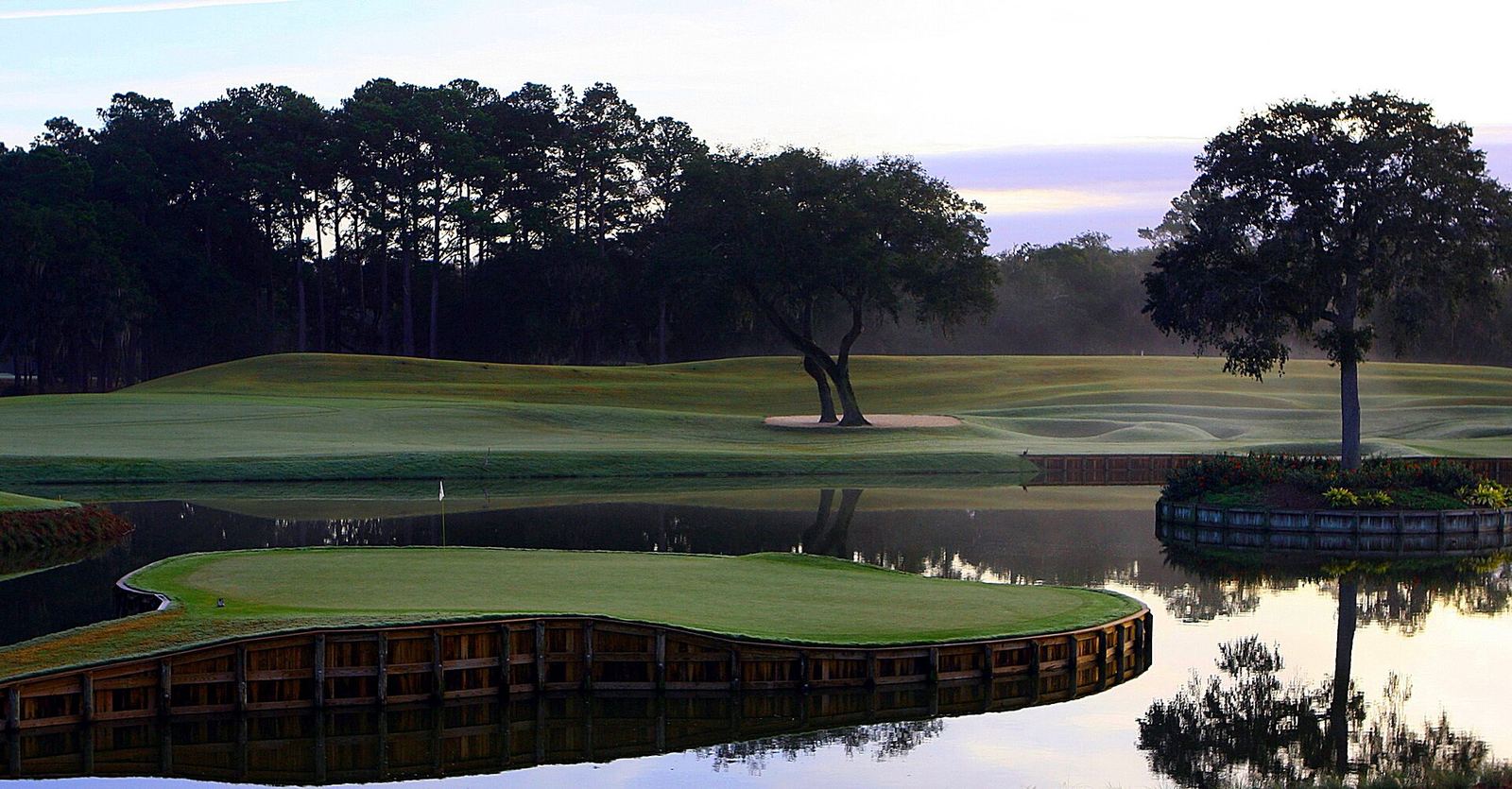
The Stadium Course has hosted the Players Championship since 1982, and it is the one course in Florida where an ordinary golfer can stand exactly where the pros stand and hit exactly the shot they hit. That shot, of course, is the 17th: a wedge or short iron to an island green, usually credited to Alice Dye, with a bulkhead, a thin collar and water in every direction. Pros have hit it into the lake with the tournament on the line, so don’t be embarrassed if you do. There is a drop zone for the rest of us.
The course is more than one hole. Dye built it on swamp, moving earth to create spectator mounds (hence “Stadium”) and giving every hole a clear strategic choice: the safe side is usually longer, the aggressive line flirts with water or waste bunkers, and the par-5 16th and the lake-lined 18th make the finish as dramatic as anything you can book in America. Nationally it ranks between No. 20 (LINKS) and No. 66 (Top100GolfCourses) on the overall lists, and No. 8 on both Golf Digest’s and GOLF’s public lists.
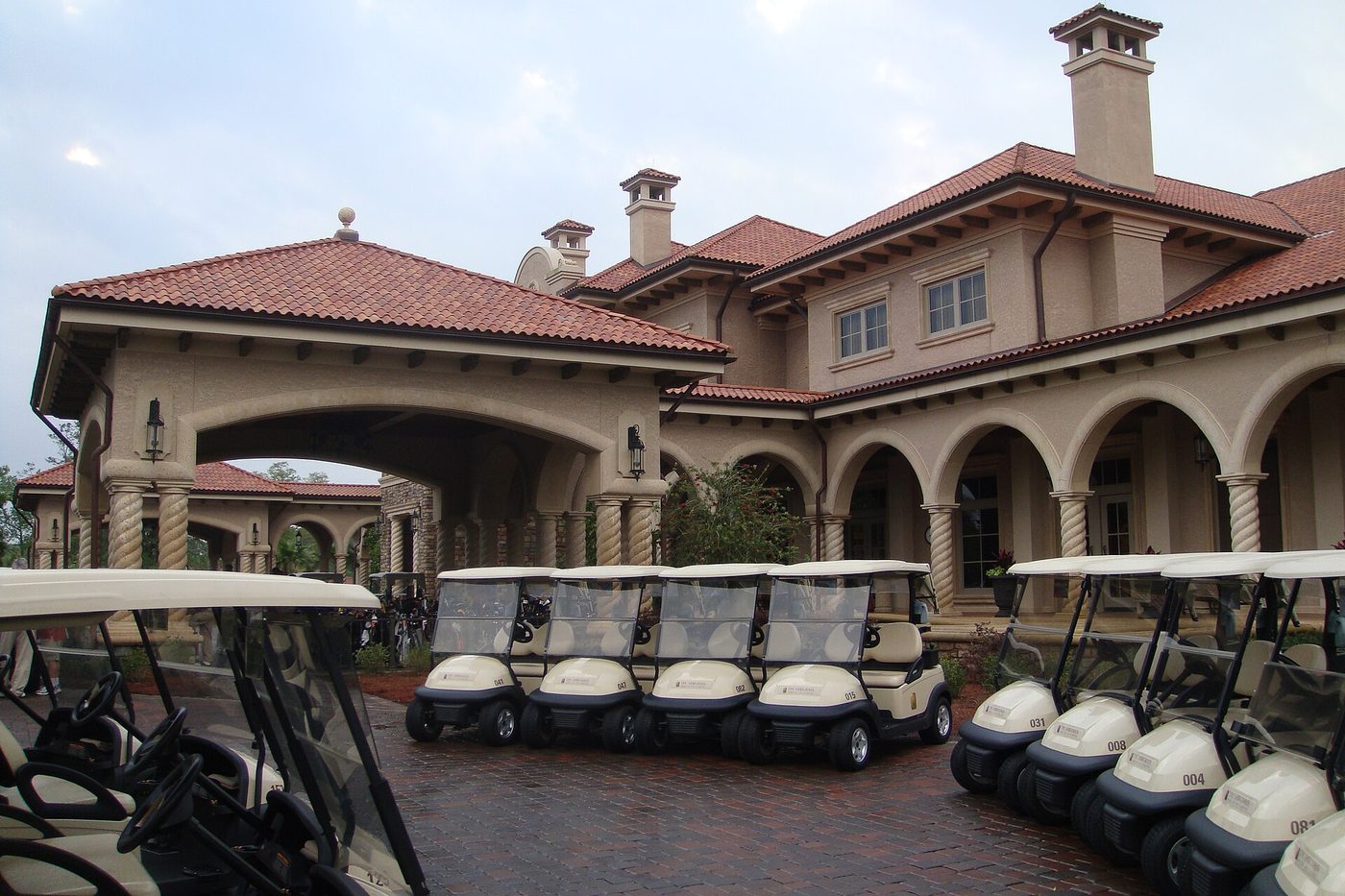
Which tees: a 10-handicap will have plenty from around 6,400 yards; an 18 should be closer to 6,000; a 25 should play the forward set and enjoy the 17th from 120 yards. Nobody pays $775 to spend the day in the water from the back tees.
Getting on: the public window is 14 days. Stay at the Sawgrass Marriott or other qualifying lodging and you can book up to a year ahead, which matters in March and April. We look at how the Sawgrass green fee breaks down, including the caddie option and the summer rate, in a separate guide.
Verdict: worth it once, especially for anyone who has watched the Players for years. On architecture alone it isn’t better than Streamsong, which costs half as much. Go between June and August, when the rate drops to $550, and play early before the afternoon storms.
TPC Sawgrass (Dye’s Valley Course)
Ponte Vedra Beach · public · Pete Dye and Bobby Weed (1987) · Par 72, 6,847 yards · back tees 74.0/134 · Green fee $250 (June-August) to $350 (September-May), cart, forecaddie and range balls included (official, September 2026) · 14 days ahead
Dye’s Valley is the other course at Sawgrass, and it gets overshadowed. It shares the Stadium Course’s clubhouse and its style, with water, waste areas, railroad-tie bulkheads and plenty of risk and reward, at less than half the price. It is about 500 yards shorter from the back tees, with a lower slope (134 against 148), so it is noticeably kinder to a mid-handicap player.
Verdict: a good pairing with the Stadium Course for a two-round day, or the better choice on its own if you want Pete Dye golf without the $775 bill. At $250 in summer, it is one of the fairer resort rates in the state.
Farther south, Jack Nicklaus’s Ocean Course at Hammock Beach in Palm Coast puts several holes right on the Atlantic dunes, and Pete Dye’s Oak Marsh at Omni Amelia Island, north of Jacksonville, is a quieter, tighter marsh course. Neither publishes a rate card; both price through their booking engines, and both are worth a look if you’re already on that stretch of coast.
Central Florida: Streamsong, Orlando and the Nature Coast
The middle of the state is where Florida golf gets interesting. Streamsong, an hour south of Lakeland, is the best public golf in Florida and among the best in the country. Orlando has more good public golf than its theme-park reputation suggests, and on the Nature Coast north of Tampa, the old World Woods has been reborn under a new owner. We cover the rest of Central Florida, including Innisbrook’s sister courses and the Nature Coast, in its own guide.
Streamsong (Red, Blue and Black)
Bowling Green · resort/public · Red: Bill Coore and Ben Crenshaw; Blue: Tom Doak; Black: Gil Hanse (2017) · Par 72 (Red and Blue); Blue 7,276 yards · Ratings conflict between sources, so we don’t quote one · Green fee: resort guest $150 (summer) to $395 (January-April 2027), day guest $200 to $445, plus $35 for a cart; the same rate card covers all three courses (official, September 2026) · walking encouraged; caddies about $100-$120 a bag, and a caddie is required if you ride or play in the first three tee times · day guests book 30 days ahead
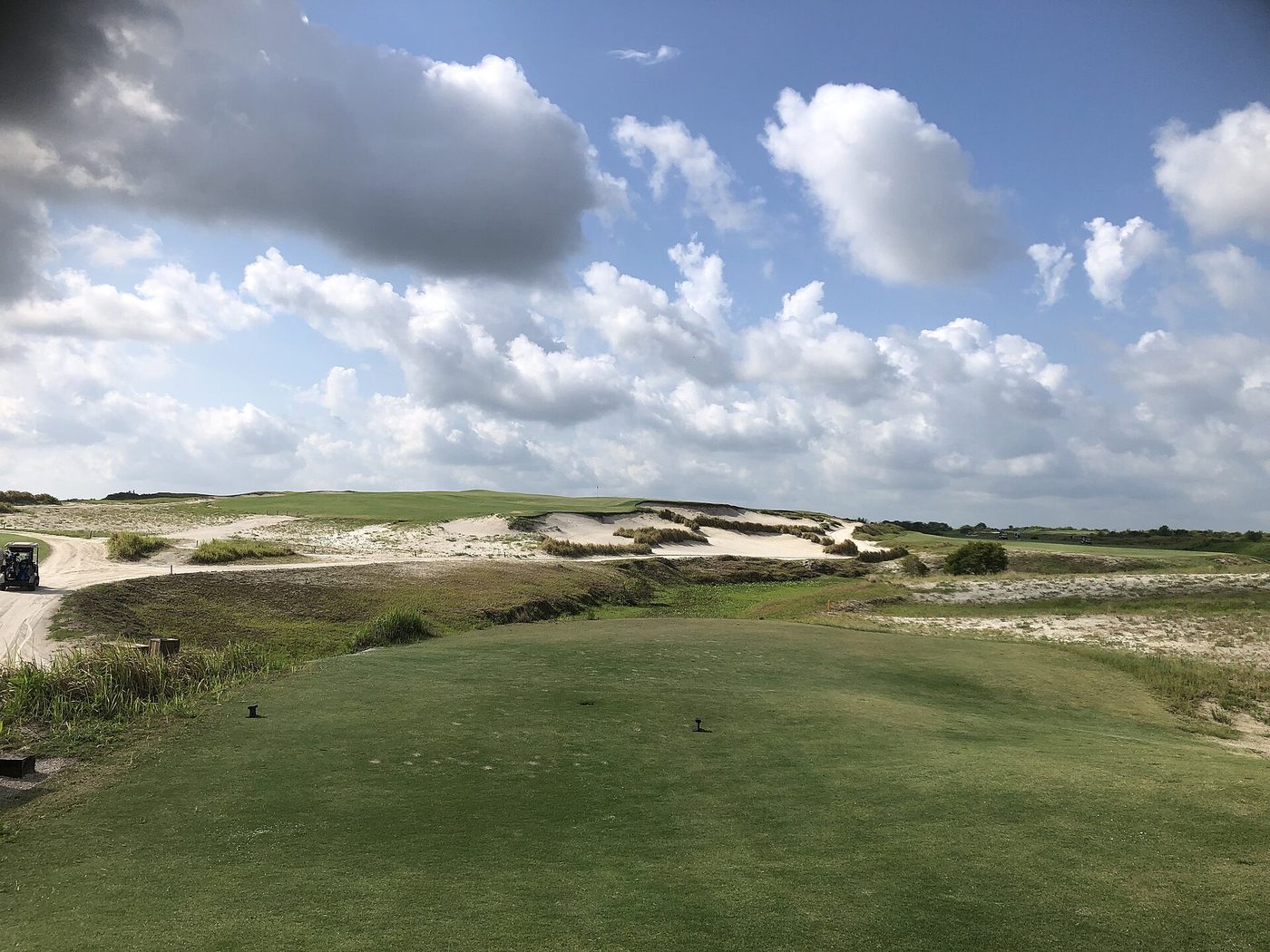
Streamsong was built on a former phosphate mine owned by Mosaic, the fertiliser company, and the mining left behind something Florida doesn’t have naturally: big sand hills, deep lakes and dramatic, open ground. Three of the best architects in the world were given that land, and the result is the closest thing Florida has to Bandon Dunes. The courses play firm and fast, the fairways are wide, the wind blows, and the ground game matters in a way it simply doesn’t on the typical watered, tree-lined Florida resort course.
Red (Coore and Crenshaw) is the one the panels rank highest: No. 3 in Florida on GOLF’s list, No. 97 on GOLF’s national list and No. 78 on the LINKS 100. It is subtle and strategic, with greens that reward a player who reads the slopes and lands the ball short. Blue (Doak) is bolder, with more dramatic green sites, and its par-3 7th over water to a dune-framed green is one of the most photographed holes in the state. Red and Blue opened together and share the same land, criss-crossing each other. Black (Hanse, 2017) sits on its own a few miles away, on higher, sandier ground, with enormous greens and the most width of the three. It suits the average golfer best and the 25-handicap most of all.
Which tees: Streamsong plays long because of the wind and the firm, sandy surrounds you will be chipping from. A 10-handicap should play about 6,300 yards, an 18 about 5,800 and a 25 the forward set. There’s no shame in it; Coore and Crenshaw build courses where the hard part is the ground near the green, not the length.
Getting on: day guests can book 30 days out. Resort guests get the lower rate and an earlier window. The resort is a long way from anywhere (the nearest airports are Tampa and Orlando, both about 90 minutes away), so most people stay; if you’re driving in for the day, book a morning time on the course you want most and take the replay if it’s offered. We rank how the three Streamsong courses compare, hole by hole, in a separate guide.
Verdict: the best golf you can book in Florida, and in summer, at $200 for a day guest, the best value too. If you can play only one Florida resort, make it this one. Play Red and Blue in the same day if you can walk 36.
Arnold Palmer’s Bay Hill Club & Lodge
Orlando · members and lodge guests only (no more than two golfers per room) · Dick Wilson (1961) · Par 72, 7,381 yards · back tees 75.2/138 (reported) · Green fee about $285 in high season plus a mandatory forecaddie at $30-$40 a player, or a caddie from $100 plus tip (reported, March 2026) · walking with a forecaddie or caddie · booked as part of a stay
Bay Hill is Arnold Palmer’s club, and it hosts his PGA Tour event, the Arnold Palmer Invitational, every March. It is a tough, traditional course by Dick Wilson, with long par 4s, lots of water on the back nine and an 18th green set hard against a lake, which has decided more than one Invitational. The atmosphere is the reason to go: it still feels like Palmer’s club, with his memorabilia everywhere and his standards on the course.
Getting on: you have to stay at the lodge, and each room can bring no more than two golfers. That makes it a planned trip rather than a spur-of-the-moment round.
Verdict: for Palmer fans and Tour watchers, a stay here is a memorable weekend. As golf alone, it is a good championship course rather than a great one, and a pure-architecture fan would get more from Streamsong for similar money.
Orange County National (Panther Lake)
Winter Garden · public · Phil Ritson, David Harman and Isao Aoki (1997) · Par 72, about 7,300 yards · back tees 75.7/137 (reported) · Green fee not published as a fixed rate card (dynamic pricing through the club’s booking engine) · cart usually included
Orange County National is the best-known daily-fee course in Orlando, and Panther Lake is its main course. It has hosted the final stage of PGA Tour qualifying and is big, wide and well conditioned, with little housing to get in the way. It is a proper championship-length test from the back tees and a very playable course from the forward ones, and the practice facility is one of the largest in the state.
Verdict: the safe, solid choice for a round in Orlando without a resort bill. Check the dynamic rate the week you want to play; mid-afternoon times in summer are usually the cheapest.
Cabot Citrus Farms (formerly World Woods)
Brooksville · resort/public · original courses by Tom Fazio (early 1990s), rebuilt and renamed under Cabot · Green fee not published; cart $35 a player from March 1 to December 13, and walking only from December 14 to February 28 (official, September 2026)
World Woods, an hour north of Tampa, used to be Florida’s great cult public course: two Tom Fazio 18s, Pine Barrens and Rolling Oaks, set in sandy, piney land that looked more like the Carolinas than Florida. It has been bought and rebuilt by Cabot, the company behind Cabot Links and Cabot Cliffs in Nova Scotia, and its two 18s now go by the names Karoo and Roost. The rebuild leans into firm, walkable, sandy golf in the Streamsong mould, and the winter walking-only rule tells you what kind of golf it wants you to play.
Verdict: the course to watch in Florida. We haven’t seen the rebuilt holes, and the resort doesn’t publish green fees, so check both before planning around it. On the strength of the land and the owner’s record in Nova Scotia, it has every chance of becoming a Streamsong rival.
A quick Orlando note: The Ritz-Carlton Golf Club at Grande Lakes, a Greg Norman design that normally sells public tee times up to four months ahead, is closed for renovation from April 24 to October 31, 2026. Its pre-closure public rate ran $299 to $375. Mission Inn’s El Campeon course in Howey-in-the-Hills, which dates to 1917 and has real elevation change for Central Florida, is the value alternative, with rates reported at $59 to $98.
Tampa Bay: Innisbrook, a TPC and the city’s cheap munis
Tampa is the most underrated golf market in Florida. It has a Tour venue, a TPC, and city courses that cost less than a movie ticket in summer. Tampa’s public courses get their own guide; the highlights are below.
Innisbrook Resort (Copperhead Course)
Palm Harbor · resort guests (two-night minimum) and members · Larry Packard (1974) · Par 71, 7,340 yards · back tees 75.6/144 (reported) · Green fee: sold as part of a stay; a Copperhead upgrade on a package is reported at $85 Monday to Thursday and $115 Friday to Sunday · booked with a stay
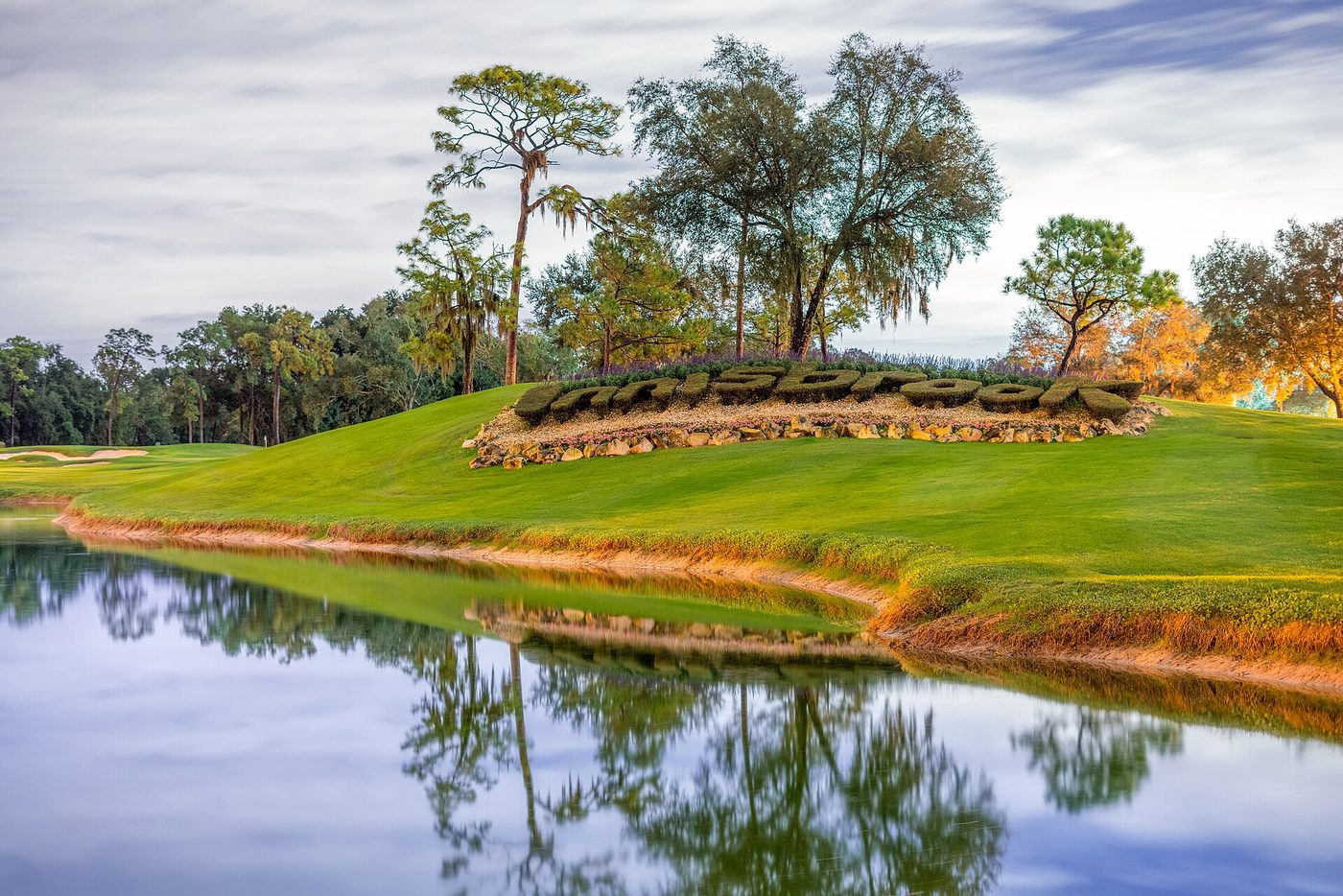
Copperhead hosts the PGA Tour’s Valspar Championship every March, and it is one of the few Florida courses the pros praise for its terrain. It rolls, which in Pinellas County is unusual, and it is lined with tall pines rather than housing. The closing stretch, the 16th, 17th and 18th, is known as the “Snake Pit”, and it is exactly as uncomfortable as it sounds for a mid-handicap player.
Getting on: you need a room, with a two-night minimum. Innisbrook’s other courses, Island, North and South, come with the package and are worth playing, especially the Island.
Verdict: a very good course, and a good-value package if you’re playing several rounds. It isn’t one to plan a single round around; the two-night minimum makes that impossible anyway.
TPC Tampa Bay
Lutz · public · Bobby Weed with Chi Chi Rodriguez (1991) · Par 71, 6,898 yards · back tees 73.9/139 · Green fee $125 to $249 on weekdays and $150 to $279 at weekends, dynamic pricing (official, September 2026)
TPC Tampa Bay is a stadium-style course built for the Champions Tour, and for years it hosted a senior event. It is a wetland course, with water and cypress on most holes, and it plays shorter than Sawgrass but asks a lot of your iron play. The dynamic pricing means summer afternoons can be very reasonable, while Saturday mornings in February cost as much as a lesser resort.
Verdict: good, well-conditioned golf with a TPC feel for a fraction of Sawgrass money, if you book the low end of the dynamic range. At the top of the range, you would do better driving to Streamsong.
If price matters most, Rocky Point, a City of Tampa course on the causeway side of the bay, publishes rates of about $35 on weekdays and $39 at weekends with a cart. It is flat and simple, but it is well kept and on the water, and it is the cheapest round in this guide.
Palm Beach County: Seminole’s neighbourhood
Palm Beach County has the heaviest concentration of top-ranked private golf in America, from Seminole up through Jupiter Hills and the Hobe Sound clubs. For the rest of us, it has one Tour course that needs a hotel stay and the best new municipal course in the country. The public courses of Palm Beach County are covered in their own guide.
PGA National Resort (Champion Course)
Palm Beach Gardens · resort guests and members · Tom and George Fazio (1981); Jack Nicklaus redesign (2014) · Par 72, 7,048 yards · back tees 75.2/148 (reported) · Green fee about $450 in high season plus a $70 mandatory forecaddie from December to April; package surcharge reported at $120 (June-September) to $175 (October-December) · forecaddie required in season
The Champion Course is the long-time host of the PGA Tour’s Palm Beach event, now the Cognizant Classic, and its signature is the “Bear Trap”, the stretch from the 15th to the 17th that Jack Nicklaus rebuilt. Two par 3s over water sandwich a par 4 with water down the right, and the wind off the Atlantic usually blows across them. A slope of 148 from the back is as high as anything in this guide.
Getting on: resort guests and members only. In high season the forecaddie is mandatory, which adds $70 to an already expensive round.
Verdict: a fair test and a famous stretch of holes, but at around $500 all in, it’s hard to recommend over Sawgrass for a Tour experience or Streamsong for the golf. Play it if you’re staying there anyway.
The Park (West Palm Beach)
West Palm Beach · public (city-owned) · Gil Hanse and Jim Wagner (2023), on the site of the old city course · Par 72, 6,800 yards · Green fee: Florida residents $180 weekday and $188 weekend; non-residents $230 and $248; West Palm Beach residents from $100 with a $25 resident card (September 2026) · walking allowed
The Park is the most exciting public golf project in Florida in years. Gil Hanse and Jim Wagner, who also redesigned the Blue Monster at Doral and restored the North Course at Los Angeles Country Club, rebuilt the old West Palm Beach municipal course, with backing from the investor Dirk Ziff, as a walkable course with firm fairways, bold bunkering and some of the best green complexes in the state.
Which tees: The Park isn’t long, but the greens and the bunkering around them are serious. A 10-handicap should play the full 6,800 only if they’re confident in their iron game; otherwise, move up a set. An 18 should be around 6,000 yards and a 25 around 5,400.
Verdict: for a local with the resident card, the best-value golf in Florida by a distance. For a visitor at $230, it’s still a better course than several resorts that charge more. Walk it.
Miami and South Florida
Miami’s golf is a mix of one expensive Tour-history resort and two very good public courses owned by local government. For Miami, Fort Lauderdale and the rest of South Florida, we have a fuller regional guide.
Trump National Doral (Blue Monster)
Miami · resort/public · Dick Wilson; Gil Hanse redesign (2014) · Par 72, about 7,600 yards from the back tees · Rating and slope not published · Green fee $566 to $714 in 2026, including cart, plus a mandatory $37 forecaddie fee and gratuity (reported) · hotel guests get priority
The Blue Monster hosted a PGA Tour event every year from 1962 to 2016, and it is one of the most recognisable courses in Florida, thanks to the lake that runs the full length of its 18th hole. Gil Hanse’s 2014 redesign made it longer, firmer and harder, with bigger bunkers and more water in play. It is tough from any tee and brutal from the back.
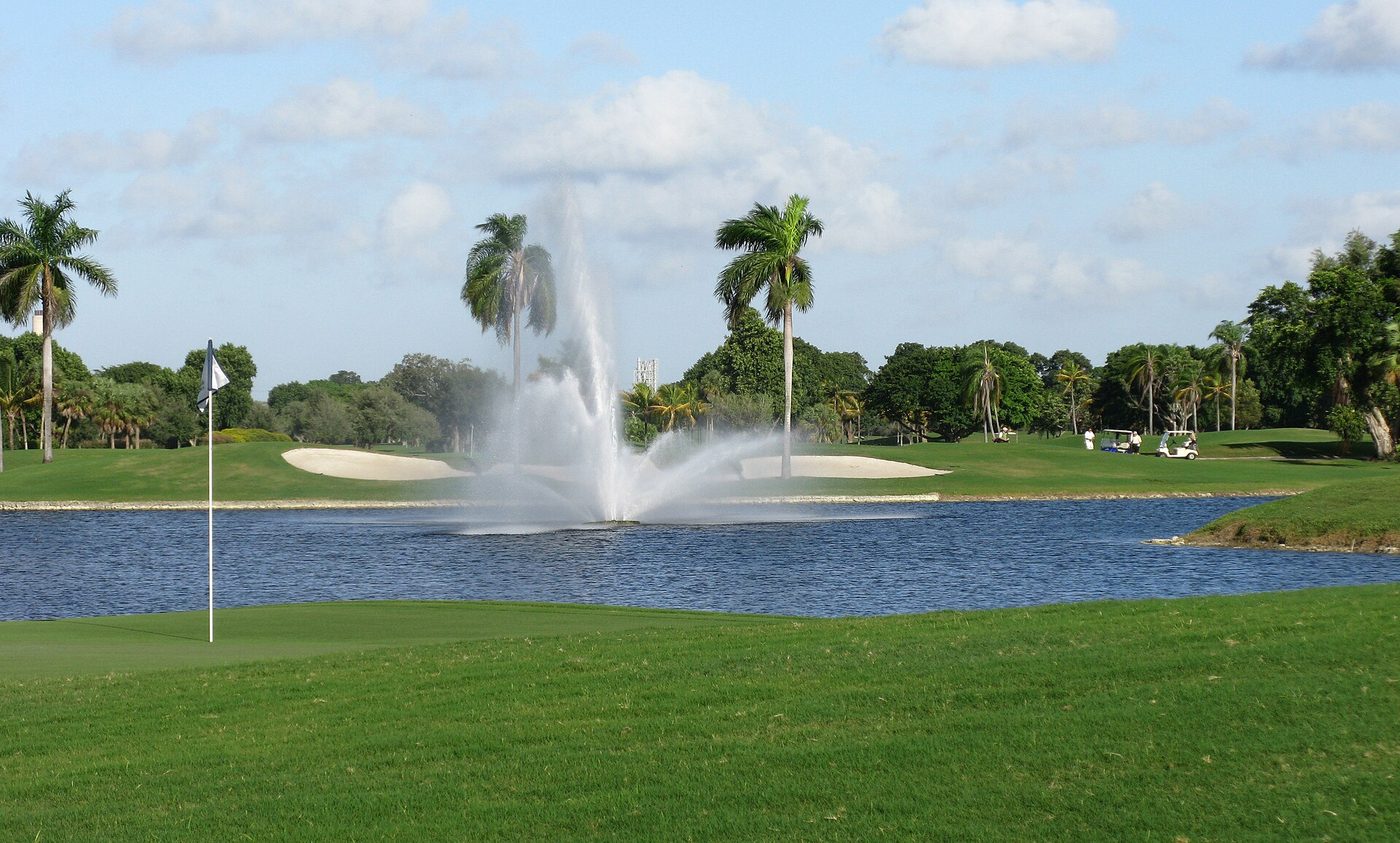
Verdict: not worth it at that price. At $600 or more once the forecaddie and tip are added, it costs close to Sawgrass and is ranked well below it (No. 25 on GOLF’s Florida list against No. 2). Play Crandon instead and spend the difference on dinner.
Crandon Golf at Key Biscayne
Key Biscayne · public (Miami-Dade County) · Robert von Hagge and Bruce Devlin (1972) · Par 72, 7,182 yards · rated about 75 from the back tees; published slope figures conflict, so check the scorecard · Green fee $120 on Mondays, $159 Tuesday to Thursday and $179 Friday to Sunday and holidays, with cart; walking rates are lower; Patron Card holders from $65 (official, September 2026)
Crandon is the best public course in Miami, and it’s owned by the county. It sits on the island of Key Biscayne, on the bay side, between mangroves and Biscayne Bay, with the Miami skyline across the water. Von Hagge and Devlin gave it water on most holes and some genuinely hard long par 4s; the wind off the bay decides how hard it plays. It used to host a Champions Tour event, and it still feels like a tournament course.
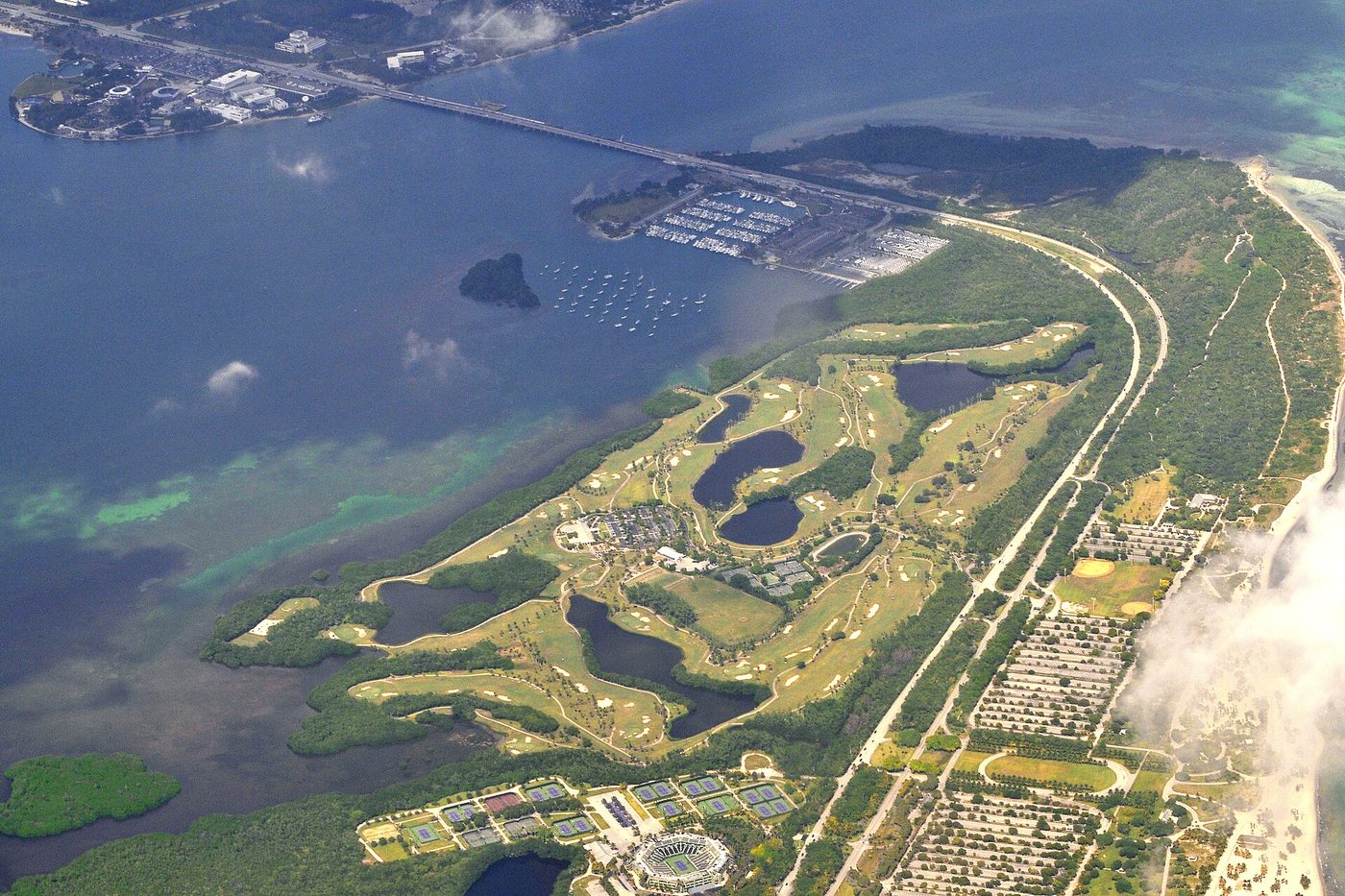
Verdict: worth every dollar, and the best Monday golf deal in South Florida at $120. Take a walking rate if you can handle the heat; the course is flat.
Miami Beach Golf Club
Miami Beach · public (city-owned) · original 1920s course; Arthur Hills redesign (2002) · Par 72, 6,800 yards · Rating and slope not published on the rate page · Green fee $163 in summer (May-October), $176 in the shoulder season (November to mid-December) and $273 in peak season (mid-December to April) (official, September 2026) · book 5 days ahead; lower rates for South Florida residents
Miami Beach Golf Club is a city course in the middle of Miami Beach, a few blocks from the ocean, and it is kept to a much higher standard than most munis. Arthur Hills’s redesign gave it lakes, palms and clean, fair holes that suit most handicaps. It isn’t a destination course, but it’s convenient and reliable.
Verdict: a good summer round at $163 if you’re staying on the beach. At $273 in peak season, you’re paying for location; Crandon is the better golf for less.
Southwest Florida: Naples, Fort Myers and Sarasota
Southwest Florida is mostly private golf in gated communities; Naples alone has dozens of member-only clubs. Southwest Florida’s public options are thinner than the course count suggests, but there are two genuine Donald Ross municipal courses here, and one resort course that hosts an LPGA major.
Bobby Jones Golf Club (Donald Ross Course)
Sarasota · public (city-owned) · Donald Ross (1926); Richard Mandell restoration (reopened 2023) · Par 72, 6,467 yards · back tees 71.3/129 · Green fee $74 to $114 on weekdays and $84 to $124 at weekends in peak season (December 22 to March 31), with discounts of around 40% for city residents (reported, rates set in 2023; check current rates) · walking allowed
Bobby Jones is a Donald Ross course owned by the City of Sarasota, and after years of decline it was restored by Richard Mandell and reopened in 2023. Mandell brought back Ross’s green shapes and rebuilt the bunkers, and the result is a genuinely good, walkable, historic course at a municipal price. It isn’t long, but Ross’s greens do the work, with falloffs that repel anything off line.
Verdict: one of the best-value rounds in the state, and a real piece of golf history. Play it if you’re anywhere near Sarasota.
Fort Myers Country Club
Fort Myers · public (city-owned) · Donald Ross (1917) · Par 71, 6,421 yards · back tees 70.5/118 · Green fee not published on the city’s site (reported under $60 in season) · walking allowed
Fort Myers Country Club is one of the oldest courses in this guide, a 1917 Donald Ross design that the city still runs as a public course. It is short, flat and not especially hard (a slope of 118 is below average), but it’s a real Ross routing, and the price is the lowest of any course in the region with this pedigree. It’s a very good course for a 25-handicap or a beginner who wants to play something with history.
Verdict: worth playing for the history and the price, not for the challenge. Call ahead for the current rate.
The best-known Southwest Florida resort course is Tiburon’s Gold Course in Naples, a Greg Norman design at the Ritz-Carlton that hosts the LPGA’s CME Group Tour Championship. Tiburon prices through its booking engine rather than publishing a rate card, and Ritz-Carlton Naples guests get access at a discount, so check both before comparing. Calusa Pines, as above, is private.
The Panhandle: Destin, 30A and the resort courses
The Panhandle is Florida’s other golf region, more like Alabama than Miami in climate and feel, with white-sand beaches and resort golf that is mostly tied to a stay. We cover the public courses around Destin and 30A in their own guide; the two best courses there both need a room.
Camp Creek Golf Club
Panama City Beach · guest-only (Watersound Club members and guests of affiliated resorts, including the WaterColor Inn) · Tom Fazio (2001) · Par 72, about 7,159 yards · Rating and slope not published · Green fee about $295 including cart; no public or twilight rates (reported)
Camp Creek is Tom Fazio’s best work in the Panhandle, a wide, open course with big sandy waste areas and native grasses that play more like the Carolina Sandhills than typical Florida golf. It isn’t open to the general public. You need to be a member of the Watersound Club or a guest at one of its affiliated resorts.
Verdict: the best course in the Panhandle, and worth building a stay around if you’re heading to 30A anyway. There’s no way to play it for a day without a room.
Sandestin Golf and Beach Resort (Burnt Pine)
Miramar Beach · resort guests (tee times after 1 pm, up to six months ahead) and members; other players up to 14 days ahead · Rees Jones (1994) · Par 72, 7,001 yards · Course rating 74.7; slope not published · Green fee not published; cart and range balls included (official, September 2026)
Burnt Pine is Sandestin’s best course, a Rees Jones design that runs out along Choctawhatchee Bay, with several holes right on the water. Access is more restricted than the other Sandestin courses: resort guests book afternoon times, while members and their guests get the mornings.
Verdict: the best of Sandestin’s courses, and a good afternoon round if you’re staying at the resort. The published access rules are tight, so book as soon as your window opens.
How Florida golf courses play: bermuda, sand, water and wind
Florida golf feels different from golf in the North, and knowing why helps you pick the right course and set your expectations.
Grass. Almost every Florida course has bermudagrass fairways and, on most, bermuda or a close relative on the greens. Bermuda is grainy: the blades lean toward the setting sun, toward water and downhill, and putts running with the grain go much faster than putts into it. If you’re used to bentgrass greens up north, expect to misread your first few putts. Many courses in North and Central Florida “overseed” in the autumn, sowing ryegrass into the dormant bermuda so the course stays green through the winter. That usually closes the course, or puts it on temporary greens, for a few weeks in October or November, so check before you book.
Sand. Florida’s soil is sandy, which means courses drain quickly after the afternoon storms and play firm in the dry season. The best courses, Streamsong, Seminole, Cabot Citrus Farms and The Park, lean into this with firm, fast turf and a ground game. Resort courses on reclaimed swamp don’t; they’re watered and soft, and the ball stops where it lands.
Water. Many Florida courses were built by digging lakes to raise the ground for fairways and houses, so water is in play on most holes. That’s why the forward tees matter so much here. A 25-handicap on a course with forced carries over water will lose a sleeve of balls from the back tees and enjoy the day from the forward ones.
Wind. On the coast, especially at Seminole, Crandon, Streamsong and the Panhandle courses, the wind changes the course by the hour. A 150-yard shot can take anything from an eight-iron to a five-iron. Plan to play in the morning, when the wind is usually lighter, and take more club than you think.
Which tees should you play on Florida courses?
Play by distance, not ego. A 10-handicap belongs at 6,200 to 6,500 yards, an 18 at 5,700 to 6,100 and a 25 at 5,200 to 5,600. Florida courses play longer than their yardage in winter, when overseeded rye and damp mornings take the roll out of your drives.
That advice matters more in Florida than elsewhere because of the forced carries. From the wrong tees, the courses on this list turn into a string of water hazards; from the right ones, they’re some of the most enjoyable golf in the country. On a course with a slope above 140, the Stadium Course, PGA National’s Champion or Innisbrook’s Copperhead, move up a set even if you’d normally play the longer tees at home.
When is the best time to play golf in Florida?
For conditions, November through April: drier air, comfortable temperatures and overseeded courses at their greenest. For price, summer: from June through August TPC Sawgrass drops from $775 to $550, and Streamsong’s day-guest rate bottoms out at $200. Summer brings heat, afternoon thunderstorms and a premium on early tee times.
The detail varies by region:
- South Florida (Miami, Palm Beach, Naples): peak season runs from mid-December to April, and rates follow it; Miami Beach Golf Club goes from $163 in summer to $273 in peak. Summer is hot and humid, with a storm most afternoons.
- Central Florida (Orlando, Tampa, Streamsong): similar, with slightly cooler winters and the same summer storms. Streamsong’s rates run from $200 in summer to $445 in January-April.
- North Florida and the Panhandle: winter mornings can be cold, often in the 40s, so the best months are March to May and October to November. Summer is the busy beach season in the Panhandle, and rates follow the tourists rather than the golf.
- Hurricane season runs from June 1 to November 30. A storm can close a course for a few days or, in a bad year, much longer. Book refundable accommodation if you’re coming in August or September.
How much does it cost to play the best courses in Florida?
At the top, $550 to $775 for the Stadium Course at TPC Sawgrass and a reported $566 to $714 at Doral’s Blue Monster. Streamsong runs $200 to $445 for day guests. The best municipal courses run from about $75 to $275, and a city course like Rocky Point in Tampa is about $35.
Here is what the courses in this guide cost at peak and off-peak, based on the published rates we checked in September 2026:
| Course | Peak rate | Summer or low rate | What’s included |
|---|---|---|---|
| TPC Sawgrass (Stadium) | $775 and up (Sept-May) | $550 (June-Aug) | Cart, forecaddie, range balls |
| Doral (Blue Monster) | $714 (reported) | $566 (reported) | Cart; $37 forecaddie fee and tip extra |
| PGA National (Champion) | about $450 + $70 forecaddie (reported) | Package surcharge $120 (reported) | Resort guests only |
| Streamsong (day guest) | $445 (Jan-Apr) | $200 (summer) | Walking; $35 cart |
| TPC Sawgrass (Dye’s Valley) | $350 (Sept-May) | $250 (June-Aug) | Cart, forecaddie, range balls |
| Bay Hill | about $285 (reported) | Not published | Forecaddie $30-$40 extra; lodge stay required |
| TPC Tampa Bay | $279 (weekend) | $125 (weekday low) | Dynamic pricing |
| Miami Beach Golf Club | $273 (mid-Dec to April) | $163 (May-Oct) | Cart |
| The Park (non-resident) | $248 (weekend) | $230 (weekday) | Walking allowed |
| Crandon | $179 (Fri-Sun) | $120 (Monday) | Cart; walking rate lower |
| Bobby Jones (Ross) | $124 (peak weekend, reported) | Lower off-peak | City residents about 40% off |
| Rocky Point | $39 (weekend) | $35 (weekday) | Cart |
Three money-saving rules hold across the state. First, the difference between winter and summer at the big resorts is often $200 or more, so if you can stand the heat, summer is the time to tick off Sawgrass and Streamsong. Second, forecaddie fees and tips add $50 to $100 to the headline rate at the Tour venues, so compare the total cost, not the green fee. Third, the municipal courses have resident rates that can halve the price; if you’re staying in West Palm Beach or Sarasota for a season, the resident card or ID pays for itself in one round.
How do you book a tee time at Florida’s best courses?
Book through each course’s own website or phone line, and check the booking window first. TPC Sawgrass opens 14 days out, or 12 months with qualifying lodging. Streamsong gives day guests 30 days. Bay Hill, Innisbrook’s Copperhead and PGA National’s Champion require a resort stay.
A simple way to get the tee times you want:
- Decide whether you need to stay. Bay Hill, Innisbrook, PGA National, Camp Creek and Burnt Pine are effectively closed to day visitors. If one of them is the priority, the room is the tee time.
- Book the hardest course first. For TPC Sawgrass in March or April, that means booking qualifying lodging months ahead to use the 12-month window. The 14-day public window in peak season sells out fast.
- Check the booking window for everything else. Streamsong gives day guests 30 days, Miami Beach Golf Club 5 days, and most dynamic-priced courses open 7 to 30 days out.
- Compare the total cost. Add forecaddie fees, tips and cart fees to the headline rate before you decide; the gap between two courses can shrink or grow by $100.
- Check for overseeding closures in October and November, and for renovation closures like the one at the Ritz-Carlton Golf Club Orlando, before building a trip around a course.
- Book the earliest time you can in summer. The afternoon thunderstorms usually arrive after 2 pm, and lightning clears the course.
- Walk where it’s allowed. Streamsong, The Park, Bobby Jones and Crandon all let you walk, and the golf is better for it.
How to choose which Florida course to play
Start with what kind of golf you want, then work down to price and access.
- For the best golf, full stop: Streamsong. Play Red, Blue and Black, and walk them.
- For a Tour experience: TPC Sawgrass’s Stadium Course. The 17th is worth the price once, especially in summer.
- For value: The Park, Crandon, Bobby Jones and Rocky Point, in that order of quality.
- For history: Bobby Jones and Fort Myers Country Club, both Donald Ross municipal courses, and Bay Hill for its connection to Arnold Palmer.
- For a beginner or a 25-handicap: Streamsong Black, for its width; Fort Myers Country Club, for its gentleness; and the forward tees anywhere else.
- For a group trip with several rounds: Innisbrook, where the package includes four courses, or Streamsong, where the rate card covers all three.
If you’re looking at living on a course rather than visiting one, Florida’s golf communities are a separate subject, with their own costs and trade-offs. And if you want a longer list of Florida courses anyone can book, including dozens of good daily-fee courses that don’t make the rankings, we have a separate guide to the best public courses in the state.
Frequently asked questions
What is the best golf course in Florida?
Seminole Golf Club in Juno Beach, a 1929 Donald Ross design, is No. 1 on GOLF’s Florida ranking and No. 12 on Golf Digest’s national list. It is private. The best course you can book is the Stadium Course at TPC Sawgrass, No. 2 on the Florida list.
What is the best public golf course in Florida?
Among courses anyone can book without a hotel stay, the Stadium Course at TPC Sawgrass ranks highest, at No. 8 on both Golf Digest’s and GOLF’s national public lists. For golf alone, many players prefer Streamsong Red and Blue, which are No. 3 and No. 4 on GOLF’s Florida list and cost less.
How much does it cost to play TPC Sawgrass?
The Stadium Course costs $775 and up from September to May and $550 from June to August, with a cart, forecaddie and range balls included. Walking means a $130 caddie upgrade. Dye’s Valley, the second course, costs $250 to $350. Rates were checked on TPC Sawgrass’s own site in September 2026.
Can you play Seminole Golf Club?
Only as the guest of a member. Seminole has a small membership and doesn’t sell tee times or accept outside requests. The realistic routes are knowing a member or qualifying for an amateur event held there, such as the 2021 Walker Cup, which was played at Seminole.
Can you walk at Streamsong?
Yes. Streamsong encourages walking on all three courses, and caddies are available at about $100 to $120 a bag. A caddie is required if you take a cart or play in one of the first three tee times of the day. The cart costs $35 on top of the green fee.
When is golf season in Florida?
Peak season runs from about mid-December to April in South and Central Florida, when rates are highest and conditions best. Summer is the low season, with rates often $200 lower at the big resorts, but with heat and afternoon storms. North Florida and the Panhandle play best in spring and autumn.
What is the cheapest good golf course in Florida?
Of the courses in this guide, Rocky Point in Tampa is the cheapest, at about $35 on a weekday with a cart. For quality at a low price, Bobby Jones in Sarasota, a restored Donald Ross course, is the standout, at $74 to $124 in peak season and less for city residents.
Is TPC Sawgrass worth the money?
Once, yes, particularly in summer at $550. The 17th is one of golf’s genuine experiences, and the finishing holes are as dramatic as any you can book. On architecture alone, Streamsong is better and cheaper, so if you’re choosing one course for the golf, choose Streamsong.
How many golf courses are in Florida?
Florida has more golf courses than any other state, around 1,250 by most counts, depending on how you count resort complexes and nine-hole courses. Only a handful make the national rankings, and most of those are private clubs on the Atlantic coast.
Our verdict
The best golf courses in Florida are, at the very top, private: Seminole, Calusa Pines, Mountain Lake and Jupiter Hills are closed to anyone without a member. Below them, though, Florida has some of the best public golf in the country, and much of it has been built or rebuilt in the last fifteen years.
If you can play only one course, make it Streamsong, and ideally make it two or three rounds there. If you want the Tour experience, go to TPC Sawgrass in summer and pay the $550 rate. And if you live in Florida or spend the winter there, get to know The Park, Crandon and Bobby Jones: they’re proof that the best-value golf in the state is owned by the city. For how Florida’s best stack up against the rest of the country, see our comparison of the top-ranked courses across America.
Sources
- 30 Best Golf Courses in Florida (2022/2023), GOLF, December 22, 2022
- America’s 100 Greatest Golf Courses, 2025-26, Golf Digest
- America’s 100 Greatest Public Golf Courses, 2025-26, Golf Digest
- Top 100 Courses in the U.S., 2024-25, GOLF
- Top 100 Courses You Can Play in the U.S., 2024-25, GOLF
- The LINKS 100 U.S., LINKS Magazine
- What exactly are Course Rating and Slope Rating?, USGA
- FAQ, TPC Sawgrass
- Golf fees, Streamsong Resort
- Golf rates, Cabot Citrus Farms
- Golf, The Ritz-Carlton Orlando, Grande Lakes
- How much does it cost to play Bay Hill in 2026?, The Golf News Net, March 7, 2026
- How much does it cost to play Trump Doral in 2026?, The Golf News Net, April 30, 2026
- How can I play Innisbrook?, Golf Monthly
- How much does it cost to play PGA National’s Champion Course?, Golf Monthly
- Orange County National
- Rates and hours, Crandon Golf at Key Biscayne
- Golf, The Park, West Palm Beach
- Bobby Jones rates set, Your Observer, October 19, 2023
- Fort Myers Country Club and Mission Inn Resort & Club, LocalGreenFees
- Camp Creek membership cost, The Private Clubs
- Burnt Pine, Sandestin Golf and Beach Resort
- Rates, Rocky Point Golf Course
- Course rates, Miami Beach Golf Club
- Rates, TPC Tampa Bay
- Seminole Golf Club, Wikipedia
- Mountain Lake Golf Course, The Cultural Landscape Foundation
- Calusa Pines Golf Club and Jupiter Hills Club, America’s Golf Archives
- Top100GolfCourses USA ranking (top100golfcourses.com), checked September 10, 2026
Image credits
| Image | Photographer | Licence | Source |
|---|---|---|---|
| TPC Sawgrass Stadium Course, 17th hole (featured image) | Craig ONeal | CC BY-SA 2.0 | Wikimedia Commons |
| TPC Sawgrass clubhouse | Philip Larson from McLean, VA, US | CC BY-SA 2.0 | Wikimedia Commons |
| Streamsong Black, 5th hole | Baybay1901 | CC BY-SA 4.0 | Wikimedia Commons |
| Innisbrook Resort, Palm Harbor | Chad Davis | CC BY-SA 2.0 | Wikimedia Commons |
| Blue Monster at Doral, 18th hole | Cfmyers | public domain | Wikimedia Commons |
| Crandon Golf at Key Biscayne from the air | LBM1948 | CC BY-SA 4.0 | Wikimedia Commons |